

If you ask an SEO what “SEO” means, you’ll get an answer like, “it’s optimizing your website to ensure it shows up at the top of search engines (Google) for specific keywords.”
That’s what it’s always been, and that’s what it still is today.
However, there are two inherent problems with that description that get overlooked and taken for granted.
1) Implied focus on Google
The first issue is that whenever someone mentions SEO, they immediately think we’re talking about Google. Google has the majority of the general search market, but that doesn’t mean SEO stops there. Literally any platform that has as search feature is a search engine and how that content gets ranked in those results is based on that search engine. Even Facebook is a search engine.
Google undoubtedly has the most advanced of the search engines.
Ironically, because I know you think of Google when I say SEO, I’ll be spending my time pretty much only talking about Google in this post.
2) The statement regarding optimizing for “search engines”
This is the biggest issue I have with the average person’s definition of SEO. There’s nothing wrong with it, per se. It is an accurate description of what most SEOs do. What it lacks is the true purpose of why it’s important.
It’s this definition that I think SEO has been bastardized into technical checklists and programmatic spam. People are optimizing for a machine so they produce for a machine.
The machine cannot think; therefore, it can be manipulated.
But this is the fundamental failure of 99% of SEOs.
There are people with purpose behind that machine.
Google’s Purpose
Google’s official mission statement includes two very important details in what their purpose for search is.
“Deliver the most relevant and reliable information available.”
“Present information in the most useful way.”
That’s it. It’s people-driven.
In short, they want to provide the best search experience to users possible.
It doesn’t take a genius to understand that the true purpose of any business is to make money. Google does that in a plethora of ways, but in terms of search, the revenue model is created with search and display ads.
This revenue model is completely useless if the search engine has no real traffic. In other words, if Google’s search engine sucked, they wouldn’t make the amount of money off of search they do. Instead, Bing would be rolling in cash.
It’s obvious to see why Bing only accounts for less than 10% of the global search market at the time of writing this. Their search experience isn’t near as good as Google.
It’s so bad that they literally pay you to use Bing search through Microsoft Rewards. I used to entertain this before getting frustrated and realizing I want to make half as many searches to find the answer I was looking for on Bing.
All this to say that if Google wants to keep raking in copious amounts of cash from search ads, they need to maintain a search engine that gets users the information they are looking for the fastest and the most accurately.
That’s where their famous algorithm comes in.
The Algorithm
For advanced SEOs, stick with me for a few sentences. A lot of the following you’ll already have a pretty fundamental understanding.
In order to accomplish Google’s mission of being the best search engine, they have to create and maintain an algorithm that instantly curates these results at every search while trying to interpret the user’s search intent.
On top of this, they have to discern which content is most accurate, most authoritative, and most relevant.
That’s where the algorithm comes in.
An algorithm needs to be created and maintained in order to curate these results with varying signals that tell the “machine” which content is most accurate, authoritative, and relevant to the searcher’s query.
The original algorithm was PageRank, which essentially gave authority to websites based on how many sites linked to them. The more links a site had, the more authority it was granted.
Relevance and accuracy were then determined by the keywords on that site.
This is where SEOs became the problem.
If the algorithm could be understood, it could be exploited; and that’s exactly what happened.
SEOs Ruined Everything
Not just Google, but when online search engines became the de facto method for people researching, it became a marketer’s job to understand how their business could get recommended first.
As soon as marketers cracked this code, they called themselves optimizers of search engines and ruined the internet.
The algorithm became so easily manipulated that PBNs, keyword stuffing, and cloaking were all it took to claim the first place in Google.
The search engine was no longer reliable to users. Google had to pivot and update the algorithm.
Google introduced major updates like Panda, Penguin, and manual actions on websites breaking their spam policies.
These updates, spam policies, and manual actions continue today. Updates to the algorithm used to be every few months. Now it feels like every few days.
No matter what Google does, SEOs are trying to crack its code and manipulate results in their favor rather than the general user population.
Your business is probably not the best for the searcher, but your job is only to convince Google that it is with whatever means possible.
The end result is Google recognizing your efforts, ranking your site number one, and then ultimately Google’s true customer (the searcher) having a bad experience.
Does the SEO’s site truly deserve to be number one? Probably not.
Simon (Google) Says…
With Google’s ever-improving algorithm, they have successfully maintained the vast majority of the search market share. More searches mean more opportunity for businesses and site owners to capitalize on the traffic Google now owns.
With over 10 billion searches every day, it’s become paramount for SEOs and business owners to understand how the algorithm works in order to capitalize on that traffic.
When an action or signal is uncovered and proven to influence rank, as an SEO, you do that thing. When Google says something is important, you do that thing.
Every new piece of information, news, or leak from Google or a source close to it is a commandment we must obey.
There are people like Barry Schwartz and Search Engine Roundtable (much respect) who seemingly dedicate their lives to Google’s algorithm.
At what point is it completely illogical to obsess over it?
I had this exact conversation with Mordy Oberstein in 2024 on Wix’ SERPs Up Podcast (“Is it time to leave algorithms behind?”)
Two Steps Forward, One Step Back
If the ultimate goal for a search engine receiving 10 billion searches per day is to provide the best search experience possible, then it needs to constantly understand its users. Google needs to understand how users search and what they expect. With every improvement in search, people’s expectations change.
We’re seeing it right now with AI and LLMs.
When people change their search habits, Google tests new signals in its algorithm to meet those new expectations.
When SEOs crack an important signal, it gets abused, and Google must adjust its algorithm and update its spam policies.
Google wants people to play by their rules. The rules they believe will make the best search engine in the world. When people don’t, their web properties will get penalized via manual actions or removal from their index.
Here’s the problem with how SEO is done…
Phase 1) Google monitors search behavior and makes probabilistic determinations on what content is important to users. As a result, Google adjusts their algorithm.
Phase 2) SEOs pick up on the algorithm change and exploit it. They take advantage of the massive rank increases. The exploit turns into a checklist for SEOs. Every SEO in the world starts doing it.
Phase 3) Google either adjusts its algorithm to devalue the exploited signal or amends its spam policies. Google then penalizes websites that continually violate updated spam policies.
Phase 4) SEOs see drops in rank from their previous exploits no longer working and wait to exploit the next thing.
The cycle repeats from here over and over again until “SEO” becomes one big checklist that never actually moves the needle.
Two steps forward, one step back.
The Logical Approach
For years, Google has stood firm on the idea that people should make content for people and not the algorithm. It’s my belief that SEOs either have no idea what Google is talking about here or they think Google is lying to them.
In reality, Google is telling us that they are trying to curate the best content for searchers and trying to understand what content users find valuable. People are adjusting how they search every day, and Google is learning and adjusting every day as well.
What SEOs are doing is reacting to Google reacting. There are two degrees of separation between what searchers expect and what SEOs are doing.
SEOs > Google > Searchers
It’d make more sense if SEOs had a searcher-first approach.
- Build easy-to-navigate and understand websites for users
- Create content that answers user queries
- Create content users want to read and share
- Build authentic authority and relationships.
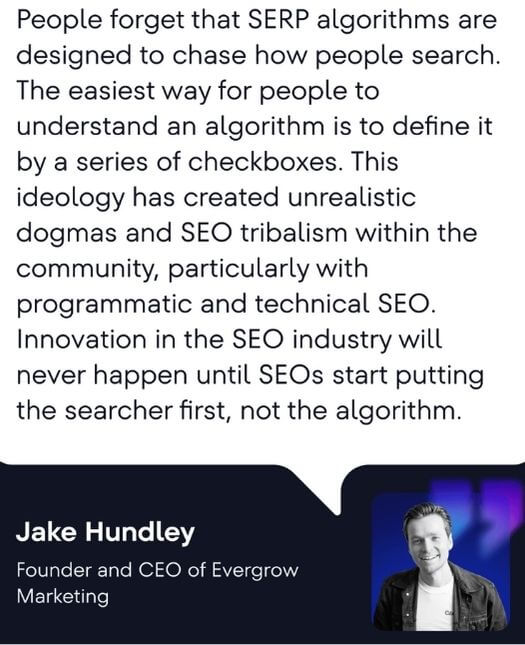
On a recent LinkedIn post from SE Ranking regarding why there is a lack of innovation in SEO, I was quoted as saying:
“People forget that SERP algorithms are designed to chase how people search. The easiest way for people to understand an algorithm is to define it by a series of checkboxes. This ideology has created unrealistic dogmas and SEO tribalism within the community, particularly with programmatic and technical SEO. Innovation in the SEO industry will never happen until SEOs start putting the searcher first, not the algorithm.”
It’s easier said than done, but that’s probably why there are fewer SEOs who are able to think critically and more who treat SEO as a programmatic checklist.
That doesn’t mean completely ignore Google and not pay attention to things Google needs from webmasters, but the bulk of what makes a page rank is not technical SEO.
Example: Doorway (Location) Pages
One strategy that a lot of local service businesses and their SEOs do is create location and service pages for every location and service they offer in that location.
For a landscaper that also does lawn care in the Chicago area, they’d create location pages like this:
- Areas We Service (a page that lists all of the suburbs they serve)
- Highland Park Landscaping
- Highland Park Lawn Care
- Arlington Heights Landscaping
- Arlington Heights Lawn Care
- Chicago Landscaping
- Chicago Lawn Care
- etc
These pages would be virtually the same, with the only difference being the location swapped out. These are, by definition, “doorway” pages in Google’s spam policies.
They are doorway pages because they exist to manipulate the search engine rather than benefit the searcher.
Our agency (Evergrow Marketing) has only engaged in white-hat-related SEO since day one. In 2019, we were told we didn’t know what we were doing by other SEOs when we explained we refused to put location pages on our client sites citing Google’s spam policies.
2022 rolls around, and Google targets location pages as part of its October Spam Update. SEOs across the world saw massive rank drops due to their location pages being indexed essentially overnight.
I wrote an article in Search Engine Land on this. It was my “I told you so” moment.
We are in Phase 4, by the way.
So what did SEOs do to counter this? They updated the content on their location pages to be unique instead of duplicate with just the keyword swapped out.
This has worked very well for SEOs all the way up until recently.
In my article 2022 Search Engine Land article, I made two predictions:
1) Updating the content to be unique will be a temporary fix. Google does not want these pages. They just have to figure out a way to understand what is and isn’t a doorway location page fairly.
2) Deindexing was Google being nice. Future Google solutions to location pages won’t be a slap on the wrist. They will likely come in the form of manual actions against sites.
That form has shown itself in scaled content abuse manual actions.
Google isn’t clear on exactly what scaled content abuse is, but I’m sure we can all use our brains and figure out what they’re talking about.
My Search Engine Land article came out in December of 2022, right around the same time was when Open AI released ChatGPT to the public. This made SEOs with hundreds of location pages able to scale their efforts to change their duplicate content pages to unique content with the help of their new “AI assistant”.
When that worked, people figured out you can use LLMs to “scale” location pages with the new exploit of “unique” content.
Again, here we are making content for search engines rather than actual users.
I still have yet to see a location page that was actually valuable to me as a user. SEOs, I’ve brought this up to try to defend it through mental gymnastics that aren’t actually grounded in reality.
Why Doorway Pages?
Google’s algorithm puts a heavy emphasis on your primary keywords in three places:
- Page Title
- H1
- URL slug
The rest of the content on the page pales in comparison to those three keyword signals. So it’s advantageous to have as many pages targeting as many target keywords as possible. In a service-based business, you want the service keyword and the location you offer that service in (“service” in “location”).
If you’re trying to manipulate a machine, this makes perfect sense.
However, imagine there was no such thing as a search engine. You just had a website address to a business that you went to. Like a digital business card.
Once you land on that website’s home page, you’d probably want to make sure they service your area. But you’re not going to look through a long list of pages that look like this:
- Highland Park Landscaping
- Highland Park Lawn Care
- Arlington Heights Landscaping
- Arlington Heights Lawn Care
- Chicago Landscaping
- Chicago Lawn Care
- etc
It’s a bad user experience. The only way I know they offer the same type of landscaping services in Highland Park as Arlington Heights is if I go to each page and look at that content. As a user, I’d rather just go to a general service areas page and see a map of everywhere they service.
If you were building a website and content that served people, this wouldn’t be it.
If you were building a website that served an algorithm, it would be it.
Location Page Alternative Solution
At Evergrow, we never built websites with location pages.
We knew the only reason SEOs poofed them into existence was to manipulate search engines with no regard to actual user experience.
As an agency focused in the landscaping and lawn care industry, we created pages that accomplished the same thing as location pages. I called these “Project Pages”.
They’re pages that target the service keyword plus the location keyword, but are focused on a specific project the client worked on. This project page included information on where the project was located, materials they used, problems they ran into, the estimated cost, the timeline, and much more.

Instead of a generic page talking about how this landscaper does “landscaping in this city”, we now have a page with the same target keywords in the Page Title, H1, and slug, but it serves as a customer-facing gallery. People looking for a similar service are served with a case-study-like gallery on a similar project to what they want in the same city they’re in.
We solved the lack of user-first content issue.
Guess who has yet to have clients lose ranking to deindexing and manual actions for scaled content.
On another note, these pages served as excellent citation sources for LLMs now that we were openly talking about pricing and giving more details about expectations around specific landscaping projects in the area.
The downside is that these can’t just be pumped out like traditional location pages. We had to actually get photos and information from our clients and create the page and copy from that.
That’s the way it should be. That’s actually high-quality content that Google wants.
For every black-hat SEO trick, there is a legitimate, future-proof white-hat method
Two steps forward, no steps back.
“bUt dOoRwAy pAgEs StiLL wOrK”
This is always what people hit me with when I explain everything I just did. And they really think they cook with this one.
If a spam policy exists, it’s because it manipulates the search engine and Google doesn’t want you doing it. Yes, Google also knows it works. They’re actively trying to make it not work.
You’re literally breaking the rules.
It will work for as long as you don’t get caught or your pages don’t flag their system.
This is like saying you can still buy drugs even though it’s illegal, so buying drugs is fine and cops don’t actually care.
This goes for everything listed in their spam policies.
A Strong Emphasis on Technical SEO is Illogical
Oftentimes the best, most researched, and authoritative content does not come from people with technical or even SEO backgrounds. It comes from doctors, teachers, mechanics, tradesmen… people who are actual experts in their fields.
An overemphasis on complicated and technical SEO would mean the truly best content that Google is after would never get sourced because technical SEO vultures would be all over it, hacking and chopping their way to subpar content they’re not experts in for the sake of ranking.
This wouldn’t produce a good user experience for searchers, and Google wouldn’t have 10 billion searches per day.
That isn’t to say that technical SEO doesn’t have its place.
Schema markup can be important for job listings if you want to show up in Google’s job rich snippets. It can also be ignored if you just want your applicants from Indeed.
Improving page speed by way of deferring JavaScript, caching content, delivering assets via CDN, etc can create a good user experience, but it’s not going to put you on page one.
When is Technical SEO Relatively Important?
In fewer places than you think.
Multinational e-commerce brands where pagination, canonicalization, and hreflang tags strategies need to be considered. In this industry, we’re not talking about the expert auto mechanic writing about his knowledge on cars no one else has. We’re simply talking about a company with the network, distribution, and resources to service a massive market and build a massive website.
Google can likely index everything, but it can’t retrieve everything for every query. It takes massive amounts of energy and money for Google to do that, and that’s why larger sites require better technical SEO.
Your local plumber?
Relax. Stick to authority and relevance.
Where Have Our Brains Gone?
The obsession over the minutiae of SEO details is absolutely crazy to me.
People obsessing over how many times their keyword shows up on a page, how many internal links their pages have, what the specific anchor text is, how detailed their schema is… the list goes on and on. None of these things will get you to the first page of Google when your authority and relevance strategy is complete garbage.
This Reddit post, for example, shows someone asking about how close the target keyword needs to be to the beginning of the page title.
This section talks about this Reddit thread where this person is obsessing over where the keyword will go in the Page title.
Title: “Keyword position in title and meta description“
Body: “I was wondering is there a difference if we use targeted keyword immediately at the beginning of title? YOAST is always warning me to move them at the beginning of title and meta description.“
My answer was pretty straight forward.
“…Whether the keyword should be at the beginning or not isn’t the question to be asked. It’s what is the intent of the search? Shaping your H1 and page title as close as possible to the actual intent of the search is the goal.”
I had also made a comment about ignoring Yoast. I love Yoast as a tool for easily adding meta descriptions and page titles, but it’s also tools like this that perpetuate this notion of procedural SEO.
No tool can tell you where your target keyword needs to belong in your page titles or H1s. No tool can tell you what the density of your keyword should actually be. Everything in SEO should be assessed from a strategic perspective which tools cannot understand.
This has to come from your brain.
If the world were overcome by a brain-eating zombie apocalypse tomorrow, I fear most people in the SEO industry would be safe.
This Post Was Not “Optimized”
This post wasn’t optimized to rank for anything. Not everything has to be.
Sometimes things just need to be said and understood the way the writer wants those things understood.