If you ask an SEO what “SEO” means, you’ll get an answer like, “it’s optimizing your website to ensure it shows up at the top of search engines (Google) for specific keywords.”
That’s what it’s always been, and that’s what it still is today.
However, there are two inherent problems with that description that get overlooked and taken for granted.
1) Implied focus on Google
The first issue is that whenever someone mentions SEO, they immediately think we’re talking about Google. Google has the majority of the general search market, but that doesn’t mean SEO stops there. Literally any platform that has as search feature is a search engine and how that content gets ranked in those results is based on that search engine. Even Facebook is a search engine.
Google undoubtedly has the most advanced of the search engines.
Ironically, because I know you think of Google when I say SEO, I’ll be spending my time pretty much only talking about Google in this post.
2) The statement regarding optimizing for “search engines”
This is the biggest issue I have with the average person’s definition of SEO. There’s nothing wrong with it, per se. It is an accurate description of what most SEOs do. What it lacks is the true purpose of why it’s important.
It’s this definition that I think SEO has been bastardized into technical checklists and programmatic spam. People are optimizing for a machine so they produce for a machine.
The machine cannot think; therefore, it can be manipulated.
But this is the fundamental failure of 99% of SEOs.
There are people with purpose behind that machine.
Google’s Purpose
Google’s official mission statement includes two very important details in what their purpose for search is.
“Deliver the most relevant and reliable information available.”
“Present information in the most useful way.”
That’s it. It’s people-driven.
In short, they want to provide the best search experience to users possible.
It doesn’t take a genius to understand that the true purpose of any business is to make money. Google does that in a plethora of ways, but in terms of search, the revenue model is created with search and display ads.
This revenue model is completely useless if the search engine has no real traffic. In other words, if Google’s search engine sucked, they wouldn’t make the amount of money off of search they do. Instead, Bing would be rolling in cash.
It’s obvious to see why Bing only accounts for less than 10% of the global search market at the time of writing this. Their search experience isn’t near as good as Google.
It’s so bad that they literally pay you to use Bing search through Microsoft Rewards. I used to entertain this before getting frustrated and realizing I want to make half as many searches to find the answer I was looking for on Bing.
All this to say that if Google wants to keep raking in copious amounts of cash from search ads, they need to maintain a search engine that gets users the information they are looking for the fastest and the most accurately.
That’s where their famous algorithm comes in.
The Algorithm
For advanced SEOs, stick with me for a few sentences. A lot of the following you’ll already have a pretty fundamental understanding.
In order to accomplish Google’s mission of being the best search engine, they have to create and maintain an algorithm that instantly curates these results at every search while trying to interpret the user’s search intent.
On top of this, they have to discern which content is most accurate, most authoritative, and most relevant.
That’s where the algorithm comes in.
An algorithm needs to be created and maintained in order to curate these results with varying signals that tell the “machine” which content is most accurate, authoritative, and relevant to the searcher’s query.
The original algorithm was PageRank, which essentially gave authority to websites based on how many sites linked to them. The more links a site had, the more authority it was granted.
Relevance and accuracy were then determined by the keywords on that site.
This is where SEOs became the problem.
If the algorithm could be understood, it could be exploited; and that’s exactly what happened.
SEOs Ruined Everything
Not just Google, but when online search engines became the de facto method for people researching, it became a marketer’s job to understand how their business could get recommended first.
As soon as marketers cracked this code, they called themselves optimizers of search engines and ruined the internet.
The algorithm became so easily manipulated that PBNs, keyword stuffing, and cloaking were all it took to claim the first place in Google.
The search engine was no longer reliable to users. Google had to pivot and update the algorithm.
Google introduced major updates like Panda, Penguin, and manual actions on websites breaking their spam policies.
These updates, spam policies, and manual actions continue today. Updates to the algorithm used to be every few months. Now it feels like every few days.
No matter what Google does, SEOs are trying to crack its code and manipulate results in their favor rather than the general user population.
Your business is probably not the best for the searcher, but your job is only to convince Google that it is with whatever means possible.
The end result is Google recognizing your efforts, ranking your site number one, and then ultimately Google’s true customer (the searcher) having a bad experience.
Does the SEO’s site truly deserve to be number one? Probably not.
Simon (Google) Says…
With Google’s ever-improving algorithm, they have successfully maintained the vast majority of the search market share. More searches mean more opportunity for businesses and site owners to capitalize on the traffic Google now owns.
With over 10 billion searches every day, it’s become paramount for SEOs and business owners to understand how the algorithm works in order to capitalize on that traffic.
When an action or signal is uncovered and proven to influence rank, as an SEO, you do that thing. When Google says something is important, you do that thing.
Every new piece of information, news, or leak from Google or a source close to it is a commandment we must obey.
There are people like Barry Schwartz and Search Engine Roundtable (much respect) who seemingly dedicate their lives to Google’s algorithm.
At what point is it completely illogical to obsess over it?
If the ultimate goal for a search engine receiving 10 billion searches per day is to provide the best search experience possible, then it needs to constantly understand its users. Google needs to understand how users search and what they expect. With every improvement in search, people’s expectations change.
We’re seeing it right now with AI and LLMs.
When people change their search habits, Google tests new signals in its algorithm to meet those new expectations.
When SEOs crack an important signal, it gets abused, and Google must adjust its algorithm and update its spam policies.
Google wants people to play by their rules. The rules they believe will make the best search engine in the world. When people don’t, their web properties will get penalized via manual actions or removal from their index.
Here’s the problem with how SEO is done…
Phase 1) Google monitors search behavior and makes probabilistic determinations on what content is important to users. As a result, Google adjusts their algorithm.
Phase 2) SEOs pick up on the algorithm change and exploit it. They take advantage of the massive rank increases. The exploit turns into a checklist for SEOs. Every SEO in the world starts doing it.
Phase 3) Google either adjusts its algorithm to devalue the exploited signal or amends its spam policies. Google then penalizes websites that continually violate updated spam policies.
Phase 4) SEOs see drops in rank from their previous exploits no longer working and wait to exploit the next thing.
The cycle repeats from here over and over again until “SEO” becomes one big checklist that never actually moves the needle.
Two steps forward, one step back.
The Logical Approach
For years, Google has stood firm on the idea that people should make content for people and not the algorithm. It’s my belief that SEOs either have no idea what Google is talking about here or they think Google is lying to them.
In reality, Google is telling us that they are trying to curate the best content for searchers and trying to understand what content users find valuable. People are adjusting how they search every day, and Google is learning and adjusting every day as well.
What SEOs are doing is reacting to Google reacting. There are two degrees of separation between what searchers expect and what SEOs are doing.
SEOs > Google > Searchers
It’d make more sense if SEOs had a searcher-first approach.
Build easy-to-navigate and understand websites for users
Create content that answers user queries
Create content users want to read and share
Build authentic authority and relationships.
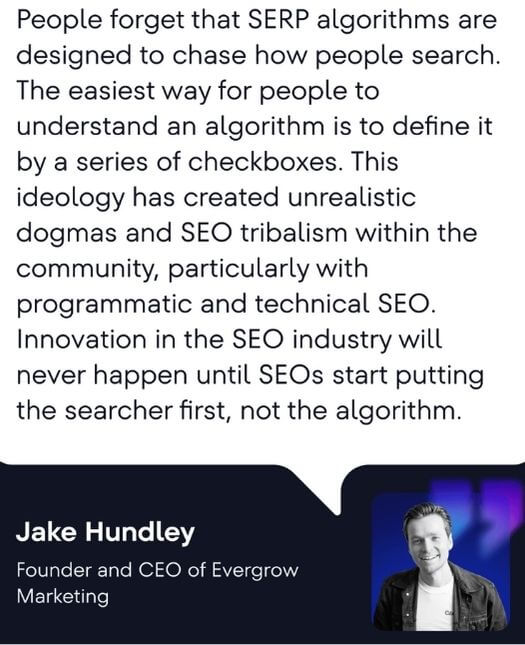
On a recent LinkedIn post from SE Ranking regarding why there is a lack of innovation in SEO, I was quoted as saying:
“People forget that SERP algorithms are designed to chase how people search. The easiest way for people to understand an algorithm is to define it by a series of checkboxes. This ideology has created unrealistic dogmas and SEO tribalism within the community, particularly with programmatic and technical SEO. Innovation in the SEO industry will never happen until SEOs start putting the searcher first, not the algorithm.”
It’s easier said than done, but that’s probably why there are fewer SEOs who are able to think critically and more who treat SEO as a programmatic checklist.
That doesn’t mean completely ignore Google and not pay attention to things Google needs from webmasters, but the bulk of what makes a page rank is not technical SEO.
Example: Doorway (Location) Pages
One strategy that a lot of local service businesses and their SEOs do is create location and service pages for every location and service they offer in that location.
For a landscaper that also does lawn care in the Chicago area, they’d create location pages like this:
Areas We Service (a page that lists all of the suburbs they serve)
Highland Park Landscaping
Highland Park Lawn Care
Arlington Heights Landscaping
Arlington Heights Lawn Care
Chicago Landscaping
Chicago Lawn Care
etc
These pages would be virtually the same, with the only difference being the location swapped out. These are, by definition, “doorway” pages in Google’s spam policies.
They are doorway pages because they exist to manipulate the search engine rather than benefit the searcher.
Our agency (Evergrow Marketing) has only engaged in white-hat-related SEO since day one. In 2019, we were told we didn’t know what we were doing by other SEOs when we explained we refused to put location pages on our client sites citing Google’s spam policies.
2022 rolls around, and Google targets location pages as part of its October Spam Update. SEOs across the world saw massive rank drops due to their location pages being indexed essentially overnight.
I wrote an article in Search Engine Land on this. It was my “I told you so” moment.
We are in Phase 4, by the way.
So what did SEOs do to counter this? They updated the content on their location pages to be unique instead of duplicate with just the keyword swapped out.
This has worked very well for SEOs all the way up until recently.
In my article 2022 Search Engine Land article, I made two predictions:
1) Updating the content to be unique will be a temporary fix. Google does not want these pages. They just have to figure out a way to understand what is and isn’t a doorway location page fairly.
2) Deindexing was Google being nice. Future Google solutions to location pages won’t be a slap on the wrist. They will likely come in the form of manual actions against sites.
Google isn’t clear on exactly what scaled content abuse is, but I’m sure we can all use our brains and figure out what they’re talking about.
My Search Engine Land article came out in December of 2022, right around the same time was when Open AI released ChatGPT to the public. This made SEOs with hundreds of location pages able to scale their efforts to change their duplicate content pages to unique content with the help of their new “AI assistant”.
When that worked, people figured out you can use LLMs to “scale” location pages with the new exploit of “unique” content.
Again, here we are making content for search engines rather than actual users.
I still have yet to see a location page that was actually valuable to me as a user. SEOs, I’ve brought this up to try to defend it through mental gymnastics that aren’t actually grounded in reality.
Why Doorway Pages?
Google’s algorithm puts a heavy emphasis on your primary keywords in three places:
Page Title
H1
URL slug
The rest of the content on the page pales in comparison to those three keyword signals. So it’s advantageous to have as many pages targeting as many target keywords as possible. In a service-based business, you want the service keyword and the location you offer that service in (“service” in “location”).
If you’re trying to manipulate a machine, this makes perfect sense.
However, imagine there was no such thing as a search engine. You just had a website address to a business that you went to. Like a digital business card.
Once you land on that website’s home page, you’d probably want to make sure they service your area. But you’re not going to look through a long list of pages that look like this:
Highland Park Landscaping
Highland Park Lawn Care
Arlington Heights Landscaping
Arlington Heights Lawn Care
Chicago Landscaping
Chicago Lawn Care
etc
It’s a bad user experience. The only way I know they offer the same type of landscaping services in Highland Park as Arlington Heights is if I go to each page and look at that content. As a user, I’d rather just go to a general service areas page and see a map of everywhere they service.
If you were building a website and content that served people, this wouldn’t be it.
If you were building a website that served an algorithm, it would be it.
Location Page Alternative Solution
At Evergrow, we never built websites with location pages.
We knew the only reason SEOs poofed them into existence was to manipulate search engines with no regard to actual user experience.
As an agency focused in the landscaping and lawn care industry, we created pages that accomplished the same thing as location pages. I called these “Project Pages”.
They’re pages that target the service keyword plus the location keyword, but are focused on a specific project the client worked on. This project page included information on where the project was located, materials they used, problems they ran into, the estimated cost, the timeline, and much more.
Instead of a generic page talking about how this landscaper does “landscaping in this city”, we now have a page with the same target keywords in the Page Title, H1, and slug, but it serves as a customer-facing gallery. People looking for a similar service are served with a case-study-like gallery on a similar project to what they want in the same city they’re in.
We solved the lack of user-first content issue.
Guess who has yet to have clients lose ranking to deindexing and manual actions for scaled content.
On another note, these pages served as excellent citation sources for LLMs now that we were openly talking about pricing and giving more details about expectations around specific landscaping projects in the area.
The downside is that these can’t just be pumped out like traditional location pages. We had to actually get photos and information from our clients and create the page and copy from that.
That’s the way it should be. That’s actually high-quality content that Google wants.
For every black-hat SEO trick, there is a legitimate, future-proof white-hat method
Two steps forward, no steps back.
“bUt dOoRwAy pAgEs StiLL wOrK”
This is always what people hit me with when I explain everything I just did. And they really think they cook with this one.
If a spam policy exists, it’s because it manipulates the search engine and Google doesn’t want you doing it. Yes, Google also knows it works. They’re actively trying to make it not work.
You’re literally breaking the rules.
It will work for as long as you don’t get caught or your pages don’t flag their system.
This is like saying you can still buy drugs even though it’s illegal, so buying drugs is fine and cops don’t actually care.
This goes for everything listed in their spam policies.
A Strong Emphasis on Technical SEO is Illogical
Oftentimes the best, most researched, and authoritative content does not come from people with technical or even SEO backgrounds. It comes from doctors, teachers, mechanics, tradesmen… people who are actual experts in their fields.
An overemphasis on complicated and technical SEO would mean the truly best content that Google is after would never get sourced because technical SEO vultures would be all over it, hacking and chopping their way to subpar content they’re not experts in for the sake of ranking.
This wouldn’t produce a good user experience for searchers, and Google wouldn’t have 10 billion searches per day.
That isn’t to say that technical SEO doesn’t have its place.
Schema markup can be important for job listings if you want to show up in Google’s job rich snippets. It can also be ignored if you just want your applicants from Indeed.
Improving page speed by way of deferring JavaScript, caching content, delivering assets via CDN, etc can create a good user experience, but it’s not going to put you on page one.
When is Technical SEO Relatively Important?
In fewer places than you think.
Multinational e-commerce brands where pagination, canonicalization, and hreflang tags strategies need to be considered. In this industry, we’re not talking about the expert auto mechanic writing about his knowledge on cars no one else has. We’re simply talking about a company with the network, distribution, and resources to service a massive market and build a massive website.
Google can likely index everything, but it can’t retrieve everything for every query. It takes massive amounts of energy and money for Google to do that, and that’s why larger sites require better technical SEO.
Your local plumber?
Relax. Stick to authority and relevance.
Where Have Our Brains Gone?
The obsession over the minutiae of SEO details is absolutely crazy to me.
People obsessing over how many times their keyword shows up on a page, how many internal links their pages have, what the specific anchor text is, how detailed their schema is… the list goes on and on. None of these things will get you to the first page of Google when your authority and relevance strategy is complete garbage.
This Reddit post, for example, shows someone asking about how close the target keyword needs to be to the beginning of the page title.
This section talks about this Reddit thread where this person is obsessing over where the keyword will go in the Page title.
Title: “Keyword position in title and meta description“
Body: “I was wondering is there a difference if we use targeted keyword immediately at the beginning of title? YOAST is always warning me to move them at the beginning of title and meta description.“
“…Whether the keyword should be at the beginning or not isn’t the question to be asked. It’s what is the intent of the search? Shaping your H1 and page title as close as possible to the actual intent of the search is the goal.”
I had also made a comment about ignoring Yoast. I love Yoast as a tool for easily adding meta descriptions and page titles, but it’s also tools like this that perpetuate this notion of procedural SEO.
No tool can tell you where your target keyword needs to belong in your page titles or H1s. No tool can tell you what the density of your keyword should actually be. Everything in SEO should be assessed from a strategic perspective which tools cannot understand.
This has to come from your brain.
If the world were overcome by a brain-eating zombie apocalypse tomorrow, I fear most people in the SEO industry would be safe.
This Post Was Not “Optimized”
This post wasn’t optimized to rank for anything. Not everything has to be.
Sometimes things just need to be said and understood the way the writer wants those things understood.
“Scientific Advertising” and “My Life in Advertising” are two books written by Claude C. Hopkins in 1923 and 1927 (respectively).
I have the combined paperback of these two books so I read both and after I did, I realized why they were combined. You only need to read the latter. It covers everything in the former and gives additional context.
Having said all that, “My Life in Advertising” was absolutely a breath of fresh air in the marketing and advertising space.
It’s everything I know about marketing without the “BS” taught in marketing courses at college and drills down to what really matters in marketing. ROI.
This is a reflection of my experience and thoughts while reading the books as well as my takeaways.
“My Life in Advertising”
It’s important to understand that Claude Hopkins was a master in “direct response marketing”; that is, getting people to respond directly to advertisements. His biggest successes aren’t of grand branding campaigns or swaying mass opinions, they were of producing and measuring the ROI of any given advertisement.
This book is especially important for you if you want to get skilled in getting people to respond immediately to ads.
Marketing is Does Not Have a Language. Your Audience Does.
Unfortunately I didn’t write down the section or chapter this is talked about but I really appreciated when this was talked about.
Hopkins takes on the corporate and technical jargon you see in ads back then and on websites today (keep in mind, this book was written in 1923).
Whenever I got to a website and I read the headline and see something like
“Our platform unlocks scalable growth by activating the latent value propositions embedded within your existing data matrix.”
You know the ones… They’re either really out of touch or really expensive. Maybe both.
I bet their sales cycle is like 6 months long but it could be 2 weeks if they just shortened it to, “We get you leads through email remarketing”.
Hopkins explains that literary prowess turns people off. If you’re trying to be poetic or too professional, it’s not going to work. Throw the college paper examples out the window and talk normal!
Two of my favorite quotes from this section are:
“The road to success lies through ordinary people”
“The great majority of men and women cannot appreciate literary style. If they do, they fear it. They fear over influence when it comes to spending money. Any unique style excites suspicion. Any evident effort to sell creates corresponding resistance. Any appeal which seems to come from a higher class arouses resentment. Any dictation is abhorrent to us all.”
If you want to get good at this, read William Zinsser’s “On Writing Well”.
Be direct. When you aren’t direct in your ad copy you scare people away.
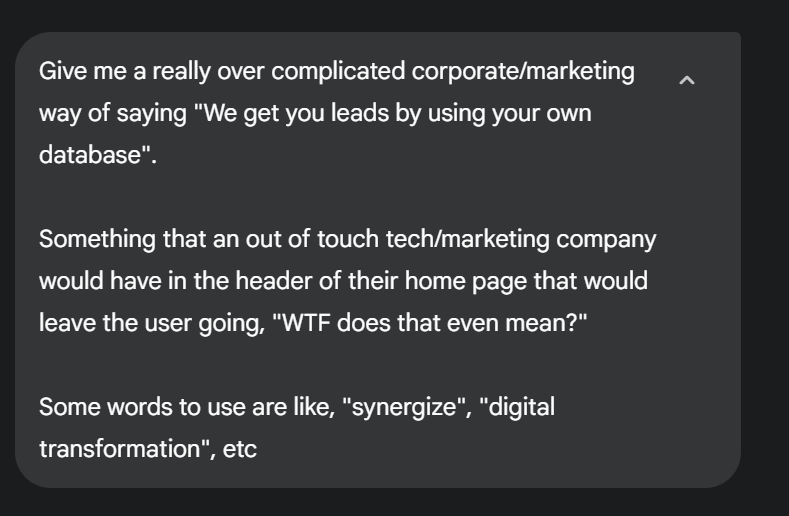
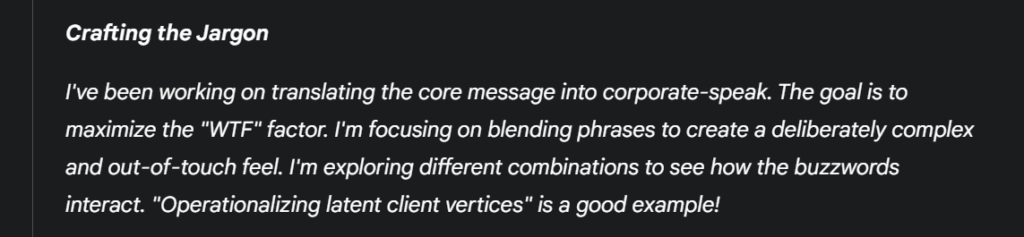
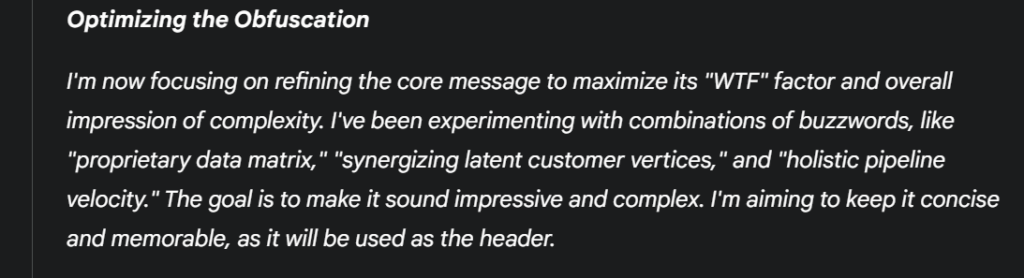
Oh, and by the way, I had Gemini write that overly complicated marketing jargon earlier. But the funniest part was when I “showed thinking”, this is what it was thinking about:
Just know that if this is you or the company you work for, even AI is making fun of you.
People Are Selfish, Not Self-Concerned (Make Them a Hero, Not a Patient)
There’s a story Hopkins explains when he worked at Bissell, he transformed how that company advertised. It used to be talking about all of the features of the carpet sweepers from their power, technology, and application that only the people designing them would care about.
There’s nothing special about carpet sweepers (what I call carpet shampooers). They get a job done and you only need one when you need one.
Hopkins transformed their approach by not focusing on the technical aspects but the social desire to have the designs that “wives wanted”. Instead of positioning it as a tool, he positioned it as a gift for the spouse and offered different styles to match visual preference.
Instead of it being something that was needed, he made it something that was desired because of the social implication of whose who.
This is something that Dyson has capitalized on in today’s world. If you don’t have a Dyson vacuum cleaner, you’re poor and everyone knows it (I’m joking…). Same goes for women and Dyson hair products.
The conclusion is that people’s buying habits shifted because people are selfish and want to the world to see them in a specific way. The husband gets it as a gift for his wife so she sees him as thoughtful. The wife wants the sweeper because all of the other wives are getting them.
My wife never wanted a Rivian SUV a month after moving to the Chicago area despite how ugly they are. They’re expensive and all the other wives in the area have them.
Consider the quote below from the book:
“Argue anything to your own advantage and people will resist to the limit. But see unselfishly to consider your customers desires and they will naturally flock to you.”
Their own advantage is the power and performance of the carpet sweeper. But the customer’s desire is to be seen as the hero to their wife or their social circle.
When I say people aren’t self-concerned, this is exemplified in Hopkins’ work with Pepsodent. He is responsible for the “film” on our teeth that brushing “gets rid of” (more on this later).
He makes a really good example of explaining how dentist and toothpaste ads don’t show dingy teeth and warn people what happens if you don’t use their product or services. Instead, they focus on making the customer the hero with a bright and shiny smile.
Would you buy toothpaste that showed someone’s gross teeth on the packaging? Probably not.
“People buy things out of pride, envy, and showmanship for selfish reasons. Trying to appeal to them to prevent possible personal issues is not as successful as showing them as a hero.”
People are 100x more receptive to advertisements that portray a higher status versus preventative issues.
In my coming book review of “Influence: The Psychology of Persuasion” by Dr. Robert Cialdini, I’ll talk about the principle of scarcity, in which Dr. Cialdini explains that people are more interested in the thought of losing something versus gaining something.
In the toothpaste example, an ad example preventing something (like dingy teeth) implies the customer does not have that yet and therefore as the opposite. Showing nice teeth on the package caters to the though of “losing the beauty standards they currently have”.
This is my interpretation of course. You can make the argument that they have a beautiful smile to gain but you can’t think about a potential gain without considering the loss. If there is nothing to lose then there is no risk in not using the product. The risk is the ugly teeth you don’t want.
Free Gifts are Not Cheap Gifts
At my agency, we typically get clients that don’t have “offers” as they feel it cheapens their brand to give discounts. That’s fair.
But the problem is when they want to move past our standard offering of SEO and Google Ads and start running Facebook or Nextdoor ads. The prospects in each of these audience segments are completely different.
When people use Google, there is already an intent to buy. When people use Facebook, they are not in the market to buy. Your ad is a distraction from what they’re already doing.
You need something to break them from the distraction and convince them that they now want what you can do for them.
You can either be an amazing copywriter… or you can give them an offer. But what kind of offer can you give that doesn’t cheapen your brand?
“Free offers cheapen the value of the product. Offer to buy the product on behalf of your customer. This forces people to make an effort to go out and buy.”
This quote from Hopkins needs a little explaining.
Hopkins typically worked with manufacturers and when he ran ad campaigns to the public the ad wouldn’t be “Get a free [product]”. It would be, “The first one’s on us!”
This phrasing doesn’t cheapen the value. It’s expressing that the thing is still full cost but you’re so confident in it, you’re covering the full cost.
If you’re considering an offer to push top of funnel prospects over the fence but don’t want to cheapen your brand, cover consider this phrasing.
When it comes to our clients (landscaping and lawn care), it’d look something like this..
Landscaper/Outdoor Living Contractor
“Your appliances on us when we build your outdoor kitchen!”
In this example, the appliances have nothing to do with the actual service but the homeowner gets to experience what you crafted for them with the appliances you got them to go with it.
Lawn Care
“We’ll buy your spring fertilizer!”
I actually have a client in Texas that does this. He gives away his first application of his multi-step lawn care plan for free and doesn’t even ask anyone to commit. When I told him he’d get taken advantage of eventually, he said, “Well, been doing it for 7 years and I haven’t been yet.”
What I like about this one for lawn care is that there are multiple ways to deliver on this. If you don’t outright give this first service away for free, you could do a discount for what it would have cost the customer had they bought it at The Home Depot themselves.
Subsequent services would not be discounted, but the customer, even though charged labor, still feels like the full cost of the raw materials was purchased by you.
Ad Creatives & Headlines
I won’t spend too much time on this one.
As the undisputed direct-response champion of the world, Hawkins was a master with ad creative and headlines to illicit massive responses from ads.
There are four key components from his ads I picked up on.
All Caps Headlines Don’t Work
I’ve seen conflicting evidence on this these days. Some things say all caps does work and some say it doesn’t. Hopkins’ argument suggesting all caps headlines not working is that people have to adjust to reading them and it’s unnatural.
The closer you can make your copy look like a piece of work that isn’t an ad, the better it’s received.
I’d still want to test this in today’s environments before taking his word for it. After all, this book was written 100 years ago…
but even Google and Facebook have policies against using all caps in ad headlines and copies.
Rewards & Benefits, not Disaster and Repercussions
Ads should focus on the rewards and benefits, not the disaster and repercussions. As mentioned previously, toothpaste companies don’t have successful ads by showing dingy teeth.
The same concept here applies to the imagery.
However, when I do my review of Donald Miller’s Building a StoryBrand (2.0), you’ll definitely see some conflicting takes here.
Miller suggests you should point out the disasters and repercussions. I’ll provide more context on that in that review.
Every Word Matters
Every book I’ve read emphasizes this. All marketing copy should be short, to the point, and clear.
This was written in a time where the majority of direct response ads were in newspapers and you were charged by the word. So every word had a cost associated to it.
But the sentiment is also reflected in Donald Miller’s teachings in “Building a Story Brand” and William Zinsser’s “On Writing Well”.
Hopkins even talks about this earlier in this book about in the quotes I shared earlier in this post regarding the language of your audience.
People do not appreciate literary style and literary style does not sell. Simple words and concepts do.
Hopkins also makes it a point that every piece of advertising material should be treated as a sales person. If a sales person sells to one person, an advertisement sells to 1,000 people.
Don’t use literary styling and prose in an ad if you wouldn’t in a sales pitch with your ideal client profile.
Ads Are not Made to Amuse
I’ll have to disagree with Hopkins here.
I don’t have to write much here, only show you a couple of quotes from the book regarding this topic:
“Ads are not made to amuse. They’re made to sell.“
“Appeal for money in a lightsome way and you’ll never get it. People don’t buy from clowns.”
If the above was true, then the now famous ads for Dollar Shave Club and Squatty Potty wouldn’t have launched those brands to success.
The only argument I could see here that would validate Hopkin’s statements would be that he is only referencing ads as they relate to direct response. Dollar Shave Club and Squatty Potty were not direct response ads. They were top-of-funnel brand ads.
Marketing Claims
Marketing claims like “The Best…” or “The Smartest…” are superlative claims. Superlative claims are expected by consumers. Every company has “the best” solutions or is the “top agency”. That doesn’t mean anything. Customers expect you to say or think you’re the best.
I love that Hopkins says this. It’s actually why I hate the phrase, “100% customer satisfaction goal” or things like that. I would hope that’s the goal. Could you imagine if you aimed for less than that?
Superlative claims are expected. Actual figures are better.
“Indefinite claims leave indefinite impressions and most of them are weak. Definite claims get full credit and value. The reader must decide that you are correct or that you are lying and the latter is unlikely.”
A definite claim is something backed by data or a survey.
“237% increase in ROI.”
“82% decrease in expenses.”
“2 hours per day saved.”
These are definite claims. These give confidence to the customer in the fact that you have done the research for them and you have gone above and beyond the expectation of superlative claims and the customer is unlikely to assume you’re lying.
The customer assumes you have done the research and they don’t have to.
“Click ‘Run'” – Dr. Robert Cialdini
… That’s a reference you’ll get when you read my review on “Influence: The Psychology of Persuasion”.
Scientific Advertising Key Takeaways
“Scientific Advertising” was written 4 years before “My Life in Advertising”. Like I said earlier, it makes sense that these books were combined. They cover the same topics but Scientific Advertising is essentially the same book without context.
Hopkins references direct response campaigns that elicited amazing responses but never said that he was the one that did them in this book. My Life in Advertising give the reader context that those examples mentioned in Scientific Advertising we all him.
Advertising is a Salesman Multiplied by 1,000
I mentioned this earlier, but and should be treated just like a sales person. The only difference is that ad speaks to 1,000 people in an instant.
A good sales person never makes the customer feel like they’re buying and a good ad should do the same thing.
“The best ads ask no one to buy. They’re based entirely on service.”
If you’ve ever read “The Little Red Book of Selling” or followed Jeffrey Gitomer, you’d be familiar with the phrase:
“People don’t want to be sold to… but they love to buy!”
The vernacular is a little different here but the sentiment is the same. People want to buy but they don’t want to be told to buy.
Speak to your audience they way they want to be spoken to, not the way you want to speak to them.
Advertising That Doesn’t Provably Improve ROI is Wasted Advertising
Before reading this book, my business partner is a strong proponent of the idea that all marketing should have ROI and if it doesn’t, then it’s money wasted.
I would argue that you can’t measure the ROI of branding campaigns and those are still important.
However, I can’t prove they’re important… I just know they are; and because I can’t, the marketer who can prove the ROI on their marketing will always be successful and justified in their work.
Our agency is a performance marketing agency. We focus on cost per lead and ROI. The two reasons we do this are because we have experience in that and that is’ the easiest thing to prove to our clients that the marketing is working. Our marketing is working.
“False theories melt away like snowflakes in the sun. The advertising is profitable or it is not, clearly in the face of returns.”
“Advertising must be done on a scientific basis to have any fair chance at success. And he learns that every wasted dollar adds to the cost of the results.”
These two quotes are the foundation of who we are at Evergrow and what we do.
Guarantees Didn’t Work in the 1920s and they Don’t Work in the 2020s.
It was refreshing to hear that guarantees in marketing were just as annoying in the 1920s as they are now.
We all see those marketing agencies and coaches that have “30-day guarantees” or “We’ll get you 30 leads in 2 weeks or your money back” type ads.
Everyone does this. The problem is that every time the guarantee is impossible to actually claim or dispute. However, everyone claims to have one.
“Many articles are sold under guarantees. So commonly that guarantees have ceased to be impressive.”
One type of guarantee today is the, “pay today and get a refund if you’re not happy.” The problem with that is they already have your money and if you’re not happy, you have to take extra steps to get it back… if you even can.
Then you have performance guarantees where you pay for the performance after the fact. But the guardrails and goalposts are so wide that even if you consider the performance “poor”, you still have to pay.
Guarantees are overdone and people easily sniff them out.
If you want to make a guarantee, let your client define the rules if you’re so confident.
“Free samples and gifts aren’t as effective as letting people try for free and then pay retail price. Additionally, if they ask for a sample after a presentation or ad, then it is just as effective.”
Focus on the Solution, not the Problem. Be the Hero.
“People will do much to cure trouble, but people in general will do little to prevent it.”
Again, this is contrary to Donald Miller’s thoughts on the topic in his “Building a StoryBrand” book. However, I lean on the side of Hopkins here.
I think it’s better to focus on the solution to a problem rather than calling out the problem itself.
The examples Hopkins gives are in the ad campaigns he ran for various brands.
He did the marketing for Pepsodent toothpaste. Talking about preventing tooth decay won’t do as well as an ad talking about how it makes teeth look beautiful. Toothpaste ads don’t advertise dingy teeth or negative outcomes.
Another example is a soap headline curing eczema. That would appeal to 1/50 people but an ad talking about smooth and shiny skin may appeal to all.
The solution, not the problem.
Summary
I’m giving this book a 4 out of 5 stars and would recommend this book to anyone in the marketing industry or anyone doing marketing for their own business.
The only reason it isn’t getting a full 5 out of 5 stars is because Hopkins partook in questionable advertising claims that elicited really good direct response results.
It’s hard to say whether his practices were 100% the result of the ad copy or some of the … no-so-true- claims he could get away with back in the 1910s and 1920s.
The majority of things talked about in the book are still relevant today and are unchanged for over 100 years!
“The time is fast coming when men who spend money are going to know what they get. Good business and efficiency will be applied to advertising. Men and methods will be measured by the unborn returns, and only competent men can survive.“
It’s been 5 years since I’ve written a book review. For reasons I won’t get into, I’ve had a fire ignited under me for the pursuit of knowledge.
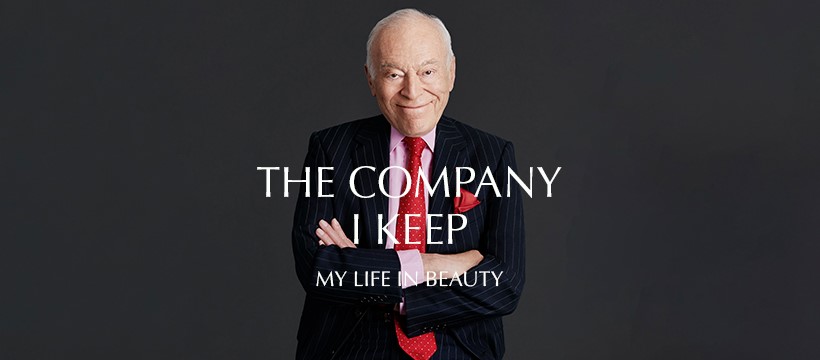
I’ve started diving into classics like 1984, Animal Farm, and Fahrenheit 451 (never mind that they all follow the same theme…). Before diving into Brave New World, my wife made me promise to read “The Company I Keep: My Life in Beauty” by Leonard Lauder.
She’s an executive in the beauty industry and previously worked for Estée Lauder Companies — when she read the book herself.
She praised the lessons given in the book by Leonard Lauder and how his advice and life lessons both validated and influenced her leadership styles with her teams. As a business owner myself, it was a no-brainer that she recommended this book to me.
As promised, I finished Fahrenheit 451 and picked up My Life in Beauty.
Synopsis / My Perspective
This is an autobiography. It’s good. And there are a lot of good lessons in leadership here.
Leonard Lauder is the son of Estée Lauder and the succeeding CEO of the Estée Lauder Companies and creator of brands like Clinique.
Obviously the book will cover a lot of the history of Estée Lauder and the company itself, which is interesting in its own right, but that’s not why the book was recommended to me.
The book was recommended because a large portion of the book has to do with leadership style’s and ideas Leonard Lauder brought to the “Family Business” after pursuing a career in the Navy. You’ll understand why I put quotes around family business in another section of this brief review.
A Family Business vs a Family in Business
This is a theme that shows up a lot in this book. There’s a difference between a “family business” and a “family in business”. In short, Leonard Lauder tackles nepotism head-on which is something I’ve always been concerned of if I had a child and they wanted to join my business.
In short, a family business is a business where the business serves the interest of the family while a family in business is a business where the family serves the business. The former is susceptible to selfish interests of family members and internal family struggles and arguments. The latter puts the business first and implies the family just happens to be in business together but all positions were earned.
Family in the Lauder Companies needed to start from the bottom and there was always a degree of management separation between the youngest Lauder and the eldest in the company.
Although I don’t think it completely squashes internal rumors of nepotism.
One of my favorite quotes in the book is actually related to this idea and that’s a quote Leonard references related to family businesses:
“… the first generation builds them, the second generation enjoys them, the third generation destroys them.”
It’s a trend he aimed to break with his own children joining the company.
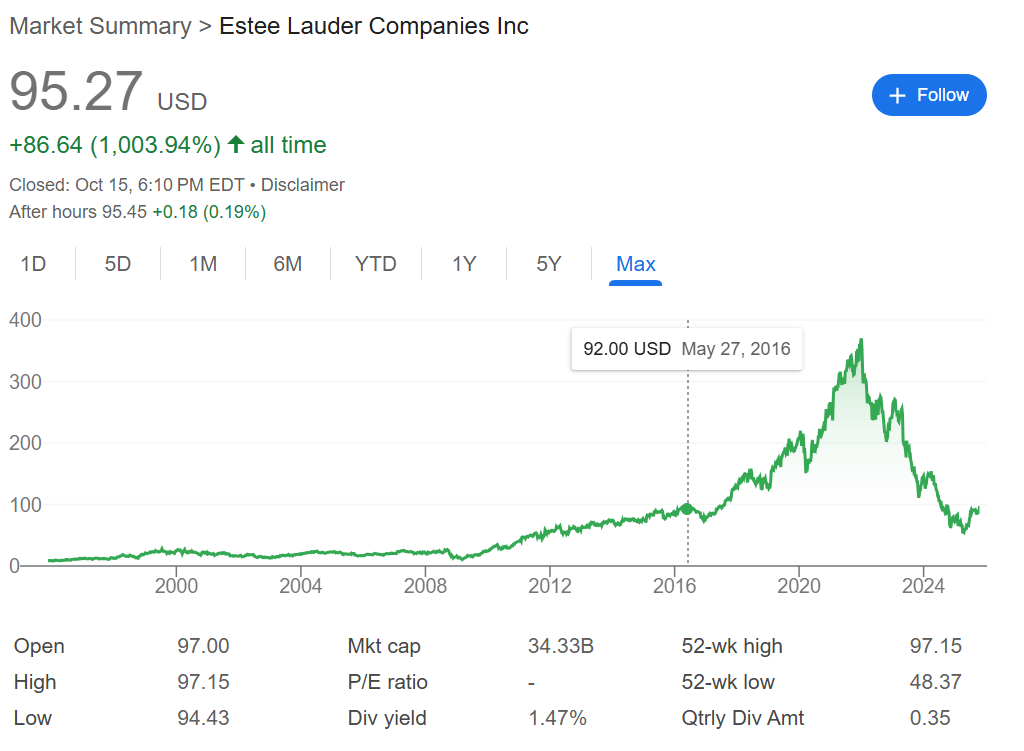
At the time of the book publishing (2020), Estée Lauder Companies stock was soaring. But the next two years saw the steepest decline since almost their early days.
As much as I enjoyed this book and his lessons, I’m not confident he “broke” this trend.
The Pussycat Clause
One thing I really appreciated from this book was “the pussycat clause”. This is probably the number one thing my wife took away from this as well as she repeated it to me quite frequently before I had even read this book.
The premise of this came from a story where in the book where Carol Phillips (former editor of Vogue) was brought on by Leonard Lauder to grow the Clinique brand.
When a well-qualified friend of hers expressed great interest in joining Carol in growing the brand, Carol responded with:
“Well pussycat, I can’t hire you… because I can’t fire you.”
I love this quote.
Cody and I actually talked about it in episode 19 of our podcast. We’re not fans of hiring our friends and family because of things that can go wrong in that relationship. It’s also not particularly comfortable telling friends and family you don’t want to hire them because of what could go wrong.
That’s like getting engaged and planning for a possible divorce.
But when you explain it like Carol did, it’s more endearing and protective.
I think if you live by this phrase and do hire a friend or family member… they should really be questioning where they stand in your relationship…
Competing Against Yourself
This is one of my favorite segments of the book.
It’s a common practice for a company to dominate a particular market or demographic and then try to appeal to another demographic, often leaning on their already established brand voice and positioning.
However, we’ve seen this fail multiple times in abysmal campaigns like:
Estée Lauder was seen as a prestige brand, it still is today; but there were emerging market trends where consumers emphasized needs for products that were fragrance and allergen free as well as products that were green an “all natural”.
Estée Lauder didn’t need to appeal to these market demands, it would have only devalued their brand in the eyes of their already captured market. A market that didn’t care about these things nor want fragrance free products.
Instead of positioning themselves as a brand that catered to all of these Leonard Lauder proposed and executed the idea of creating and owning competing brands.
Origins was created to cater to the all-natural market demand and Clinique was create to target the dermatological needs of the skin care and beauty industry.
These internal competing brands targeted multiple audience demographics without alienating their current audience with Estée Lauder.
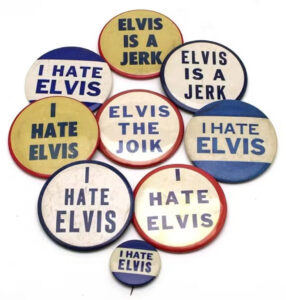
This is reminiscent of Colonel Tom Parker’s (Elvis Presley’s Manager) campaign creating “I Hate Elvis” buttons.
If there was a market that loved Elvis… there certainly was one that hated him too. Why not capitalize on both?
Applying this logic to my own business, a digital marketing agency for landscapers, if we were to add another industry or niche to focus on, such as roofers, it might make sense to create another brand.
Giving Away Your Best Product
Estée Lauder was one of the pioneers of the “gift with purchase” idea, but it didn’t start as “with a purchase”. It started as just a gift.
Estée Lauder would frequently work with department stores to have them send out letters to their shoppers prompting them to come in and get a free product from Estée Lauder. The idea is that customers would come in and purchase additional products from Estée Lauder as well as shop at the other counters in the department store.
It always worked better than everyone expected but when competitors tried to copy the idea, it fell flat on its face.
Why?
Because the free gift was never last season’s color or the weakest product that wasn’t selling just to get rid of the stock. The free gift was always one of the best products.
Always give away your best product. If someone’s first experience with your brand is with one of your worst products, why would they give you money for your other products?
Initially, my thought was, “Of course. Give them the smallest sample size of your best product. It’s not enough to make a sizeable dent in the cost of goods sold, and it makes sure the customer comes back to buy the full size once they realize they like it.”
Wrong.
Estée Lauder was giving away full sized products of her best products. Beauty is one of those industries where people become loyalists. It’s difficult to get people to switch, but once they do, you’ll have yourself a loyalist.
If you give them a full size of your best product, chances are they’ll switch to it when they run out of what they currently have. Then they’ll have yours for an amount of time they get used to it and need it again once it runs out.
It’s not about having them try the product… it’s about total conversion.
There’s more on that topic when I do my book review of “My Life in Advertising” and “Scientific Advertising” by Claude C. Hopkins.
Internal Praise and Criticism
I’m guilty of a few things here…
First, I’m bad at praising people. Even if what was done isn’t that breathtaking or groundbreaking, people like to hear “good job” and they like it when it’s said to them in front of other people.
Leonard Lauder explained how people became exceptionally motivated at the slightest amount of public praise.
Of course if public praise motivates people, then public criticism is sure to do the opposite.
All criticism should be done in private.
I’ve been guilty of this specifically and didn’t even realize I was doing it.
Just the other day I was going through a website that one of my employee’s built as we were getting ready to send to off to the client for review.
We were having a team meeting during this and talking about sending it over. During this time, I had notice da few mistakes. I was about to call them out while on the call but remembered Leonard Lauder’s words,
I held my tongue and set up a private meeting to go over the issues I found.
No one was in trouble and I wasn’t upset, but we shouldn’t point out mistakes or flaws publicly. It’s demotivating and demoralizing.
Memorable Quotes & Honorable Mentions
I’m awful at remember quotes and envy people who can recite them. So I wrote a few of them down that I really liked.
“When a person with experience meets a person with money, pretty soon the person with experience will have the money and the person with money will have the experience.” – Joseph Lauder
This was a quote Leonard heard from his father that he said was one of his greatest lessons in business.
“Trees don’t grow to the sky. They die.”
This is a quote is similar to “don’t put all of your eggs in one basket.” All trees die. You can’t expect to grow your tree (business) to the sky. It can get big but it will cap out.
Instead, focus on growing a forest of trees, no one tree.
“Committees are the death of creativity and productivity”
Leonard Lauder refers to committees as “The Anvil Chorus” which is a reference to a Spanish opera where gypsies bang on drums and sing about their life. The parallel is that too committees are like gypsies banging on drums and creating so much noise with little to no productivity.
I’m going to start referring to committees as Anvil Choruses. Maybe I’ll seem smarter.
“You can make tactical mistakes but not strategic mistakes. Tactical mistakes are ones that you make today that affect today. Strategic mistakes are ones you make today that affect tomorrow… and tomorrow’s tomorrow.”
This is probably a paraphrase. I didn’t put quotes around it in my notes on my phone, but the sentiment was meaningful enough for me to take pause and think about whether a decision I’m making is a tactical one or a strategic one.
In other words, will this decision affect only what we do today (or the immediate future) or will it have longer term ramifications? If it’s the former (a tactical decision), then quicker decisions can be favored.
Who I Would Recommend to Read this Book
I would recommend anyone in leadership to read this book. Whether you own your own business or work for one.
The book is for leaders of all kinds, but there is a lot of entrepreneurial advice and perspective to gain from it.
I don’t consider myself a great leader. I’m a nice leader, but that doesn’t mean I’m a good one. I believe the ideas in this book will continue to shape me as a leader and business owner.
I definitely recommend picking this one up. You can get it on Amazon. The audiobook is also available on Spotify (I recommend listening to it at 1.8x speed…
The worst part about writing papers in high school was citing your sources. Even if they were obvious, like quoting JFK. I assume that’s the case in college. I’m not sure. I dropped out.
That probably explains why my business partner and I ran into this problem a few months ago with one of our clients.
Because we signed an NDA on this deal, I can’t actually show the image we used or discuss the contents of it or which company hired the law firm to shake us down.
Cody and I build and market websites for a living. I’ve been doing this since 2018. He’s been on board since 2019.
Since almost all of our clients are landscaping and lawn care businesses, a fair amount of them don’t have their own photography to use. We can’t have blank websites.
So we use stock photos, specifically purchased ones from 123rf.com.
The problem is that we’re industry professionals.
We’re not going to use images that were incorrectly labeled as an armyworm when it’s a webworm.
We’re also not going to use an image of a homeowner or model spreading seed with a plastic Scotts spreader when they use commercial spreaders like Lesco.
Long story short, I couldn’t find a decent image on 123rf.com, so I turned to the ol’ Google Images.
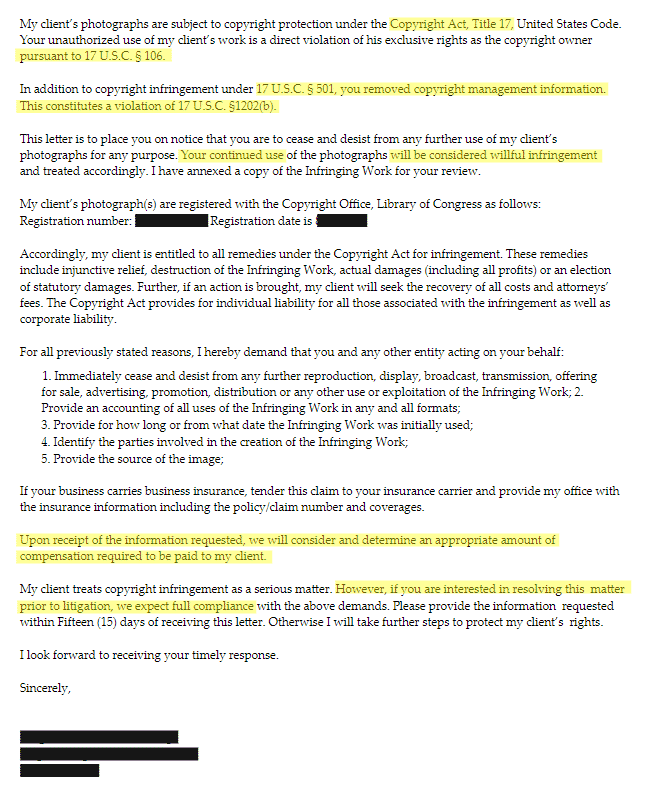
Fastforward five months and my client forwards me this:
You’ve got to be kidding me.
I can’t be too mad. I made the decision to cut a corner and it bit me in the ass.
Of course, at this time, I wasn’t entirely sure what the public domain was. But I did know images were free game there. I think I was a bit confused on what is actually labeled as such.
Still am.
Anyways, there’s a lot of fancy words and phrasing in this letter that seem pretty threatening. Fortunately, our relationship with our client was (and still is) pretty good. We reassured him we would take care of this.
Removing the image wasn’t a big deal. “Sorry. We’ll take that down” wasn’t an acceptable answer for them. Their client wanted money.
After we told them we had removed the image they thanked our client and then told us that just because we removed the image doesn’t mean their client wants to drop this.
They told us $1,500 would prevent the client from seeking further legal action.
Convenient. Since $1,500 is small enough to not go to small claims court and large enough to be a burden.
Here’s where that put us
I used an image from Google and rolled the dice. Like an idiot.
However, we weren’t too worried. We were pretty confident nothing could really come of this since we removed the image within 3 hours of receiving notification.
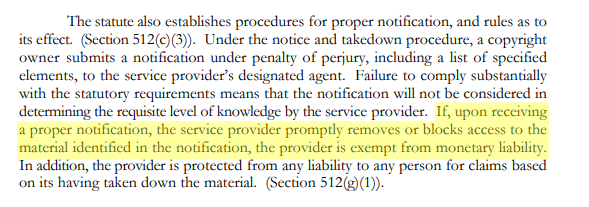
And according to US Copyright law, Code § 512, we were protected from any financial liability due to our prompt removal.
We sent this over to the law firm issuing this claim on behalf of their client (the owner of the image) and explained we were within our rights to remove the image and not be liable for any financial responsibilities.
We waited three days but didn’t hear anything back. And since this law firm was only giving us 2 weeks to respond, we assumed they just didn’t like what we had to say and weren’t going to accept that as a response.
The first option is what I wanted to do. To go tell this law firm’s client to go pound sand.
We’re clearly protected from financial liabilities since we removed the image within a timely manner. More than timely. Impressively responsive, in my opinion.
However, fighting back always brings retaliation. And the last thing we want is retaliation from a law firm for something we clearly made the first mistake on.
We even reached out to our lawyer and looped him in on everything. Since the financial compensation amount was relatively small (too small for small claims court to be worth it) we figured fighting it might be a losing battle.
Again, to us, the amount was relatively small. That’s not to say it wasn’t a lot. It was. And we didn’t want to dip into our business savings to pay for this.
Additionally, we know in court we could beat this because the law was clear. But was there something we were missing somewhere? A loophole?
I’m also not the kind of person to roll-over and accept a loss. Which is what this would have been if we just paid it.
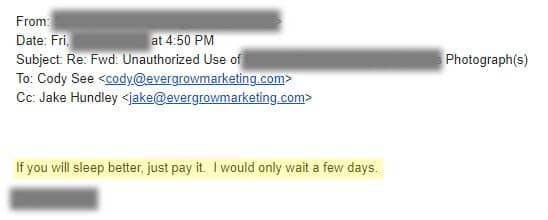
We asked our lawyer for advice and he just said to do whatever helps us sleep at night.
If you read the above header and thought we got out without paying the full $1,500. You’re wrong.
We paid them. In full.
We did this for one reason. But really three reasons.
The main reason is because it helped us sleep at night.
But the three actual reasons are:
1) $1,500 is too small for taking something like this to small claims court. We’d be paying court and lawyer consultation fees that would equal more than this amount.
2) The people who hired this lawfirm sued a major education company in the past and won. That wasn’t a challenge we wanted to take on.
3) We accepted the responsibility of my mistake.
That last one is important.
I made a mistake. And I accepted the responsibility and the punishment. Of course, we’re still curious how this would have played out had we fought back.
I think the lesson I learned most here was to accept the responsibility of your mistakes. They really do help you sleep better at night.
And you can bet your ass our library of LINCENSED images has grown exponentially since this event!
We learned that being honest with our clients is the best policy. Even when we screwed up, our client was still on our side.
We learned to pick our battles. Not every battle is worth having, especially when the victory isn’t actually coming out the “victor”.
And most importantly, we learned to just not use ANY images we don’t have explicit rights to. We also learned to document that in our processes so our employees don’t make the same mistake.
I don’t have a specific blog post for this, so I’ll include this here in case you’re curious. This would have fit better earlier in this story, but I didn’t want to detract from the main reason you started reading this in the first place.
The first question we need to ask ourselves is what images can we use. Ultimately, it’s just whoever has given you consent to use their image. It’s NOT whatever you can find on Google.
However, artists who wish to have the public use their images as if they were public domain images usually waive their copyright protections voluntarily with a “No Rights Reserved” license (CC0).
I’m still fuzzy on what that really means.
But I do know that there are a few websites where artists voluntarily upload their work for use by nearly anyone for free. A couple of them are:
Well, there’s really tons of them. But 99 Designs has a list of 31 of these sites.
A fair warning, you’re probably not going to find anything good on these sites. Public domain and anything “free” usually follows the saying, “beggers can’t be choosers”.
If you find an image you like and you’re unsure if it’s a public domain image and it’s not listed on one of the sites linked to above… GET PERMISSION TO USE IT.
Make sure it’s written. Whether it’s an email or a hand-written letter. Get permission.
The easiest way to get permission is to just pay for the damn licensing. Most photo / image sites have some kind of purchase or subscription plan.
And let me tell you what, $2 – $5 per image is a lot cheaper than a $1,500 shakedown.
Multiply that by how many images you stole and you’ll be wishing you could have paid $10 per image.
A lot of the image sites that 99 Designs listed above also include images from artists that still retain the copyright to their images, but you can typically purchase them individually or with a subscription plan.
Of course, my favorite site right now is 123rf.com.
The more I read about successful entrepreneurs, the more I realize a common theme; a fair amount of them regret never having documented their time while starting their business.
They don’t have any video diaries of their first years or even any posts or notes. I don’t want to live regretting I didn’t do that.
However, I am writing this kind of late. I started conceptualizing Evergrow in 2017 and it’s…December 22nd, 2020 at the time of this writing.
Fortunately, I do have some documents as well as a 10 minute video diary I just watched from December 2018 reflecting on the past year and a half. So I’d say I’m pretty well refreshed on my own history.
This will be the start of my posts I’ll write about my yearly journey in creating a business from scratch.
No seed investors.
No parent’s money.
No “life savings”.
Just a computer and dream (that was corny).
This one will be boring. I just always feel like we need a backstory to why a decision was made. I feel like it can provide some great context for the story later.
The Precursor: January, 2017
Mudd Advertising
It was January 2017 and I was gearing up to move to Kansas City from my home town of Cedar Falls. I needed to find a job.
I had been working at a marketing agency for about two years and had started as a Client Services Representative. It was an entry-level job making $28,000 ($14/hr) per year.
It’s here where I found my passion for marketing. I took a class in college on it… right before I dropped out, but it was Mudd Advertising that gets the credit for it.
I busted my ass here.
I worked long hours just to be the best Client Services Rep. I had eventually climbed the ranks and in less than the two years I was there to the Account Executive position for the agriculture division.
It was a fancy title for, “I get to keep all of my Client Services tasks while also managing and selling smaller accounts in the agriculture industry”. But it had effectively raised my salary to almost $40,000 after comission.
To me, $40,000 was a good amount. I think that’s what my dad was making in the early 2000s in his mid-30s.
However, I knew I was too driven to stop at $40,000 and Mudd wasn’t going to move me any higher. I had learned what I needed to know in marketing to take to Kansas City with me and make some moves.
Mudd overworked and underpaid us. It was probably one of the worst jobs I had. But it was the job that put me where I’m at now.
The Move / Hammel Scale
With my marketing background, I was able to create a compelling marketing resume despite not having any formal education in the area.
I landed a job in Kansas City, Kansas as the Inside Sales & Marketing person at Hammel Scale, a small, industrial scale distributor.
It was a small company but they gave me creative freedom with marketing at first. Plus they started me at $47,500, which was a heathy increase . I didn’t feel like I was taking a step back.
But something never felt right while working at Hammel Scale. I wasn’t educating people on digital marketing like I was at Mudd. That’s what I wanted to do. I wanted to educate and execute it.
The Catalyst: March, 2017
Around March of 2017, I was living at my new place in Prairie Village, Kansas with my then fiancée. The biggest issue with that place was the backyard was literally nothing but dirt and creeping charlies.
when it rained, our dogs would go out, get muddy, then we’d have to dry them off and wipe the mud off of their paws before they came in.
So I started looking for lawn care services to fix this problem. Maybe a full yard of grass will help.
As I was searching through Google, I noticed there were a lot…and I mean A LOT of lawn care businesses. And literally all of them except for maybe two had their Google My Business listing optimized let alone claimed.
Their websites were even worse… just God awful. It should have been a crime.
The Idea
I had never actually executed marketing for another business. I just knew about it. Sold it. Reported on it.
But how hard could it really be?
I knew there was an opportunity here. There was an opportunity to get these lawn care businesses to stand out over TrueGreen, BrightView, and the local Kansas City Metro gian, Ryan’s Lawn & Tree.
I just didn’t have a team I could turn the lead over to execute the plan.
I started where the most obvious answer was.
Optimizing their Google My Business listing.
The original idea was really simple.
A one-time, $250 fee for me to claim it and optimize it for them.
Clearly I wasn’t an entrepreur at this point. The biggest flaw in this being that this is a business model for “extra income” and not “recurring income”. And that’s probably what it was intended as when I first started it.
So I got to work on figuring out how to claim and optimize a Google business listing.
Yeah, I still didn’t know how at this point.
Needing a Guinea pig: April, 2017
I didn’t want to start doing this by calling up a random lawn care or landscaping business. I wanted to be a bit more discrete about it and make sure I was doing it right.
So I started looking at who would allow me to do this for them for free.
Churches.
Churches will take anything for free.
I reached out to a couple local churches to see if they’d be willing to let me claim and verify their Google listing. I had to meet with a couple of them to explain the benefits and the process.
The process was literally just me saying,
“I honestly don’t know how this is going to go. I used to sell these services and my team handeled it. I’m starting my own business and want to learn how to do this on my own. That’s why I’m offering this to you for free.
This is where I was able to learn how to perform simple tasks and I could actually get my business off the ground.
But I waited still. I waited until I was a bit more comfortable.
Learning & Getting Certified: May, 2017
I wasn’t yet comfortable with the idea of taking people’s money to perform a task I wasn’t an expert in. I didn’t have any confidence in this yet.
So I decided to get Google Analytics and Google Ads certified. This was something I could have done at Mudd. But it didn’t come with a pay raise, so I never did.
These classes are free on Google. They’re also extremely valuable. Especially if you ever expect to call yourself a digital marketer.
Taking these wasn’t fun. But I knew it was a step in the right direction.
Long story short, I got certified.
But in the meantime, I used my new marketing knowledge and kept applying it to my day job at Hammel Scale. This, of course, was because what I had with my business idea wasn’t really anything other than an idea at this point.
I was preparing.
That Tai Lopez Training Course
Look, we all make mistakes.
Some of us forget our anniversaries while others join MLMs, peddling products that are overpriced and poor quality. Messaging people from highschool they haven’t talked to in years with “Hey Girl!”
Mine was watching an entire Tai Lopez video ad on Facebook.
It was a video ad on starting your own 6-figure per month social media marketing agency.
It was a good-ass ad.
it was so good, I loaded my credit card up with a $1,200 charge to pay for this damn class.
Don’t make my mistake! Yes, I learned a couple things, but those things you can learn for free! The topics I learned about are below. So just take that advice and save yourself the money.
I thought it would have a lot of useful information in starting by own marketing agency.
I’m not going to lie. There were actually some good things in the video they covered. They talked about LLC vs S Corp, having confidence, and creating tiers.
It was when they started talking granularly about stuff that was just a bunch of horse shit.
Their SEO and Google Ads practices were way out of date and they were teaching things that would get you banned from search engines.
I never finished the course and received my “certification”.
At the end of the day, I’m happy I took the course, though. It did teach me some things about owning a digital marketing agency and getting set up. Beyond that. Nothing.
Niching Down
The BIGGEST takeaway from the shitty Tai Lopez course I took was a simple concept:
Find your niche.
In otherwords, if you’re going to be a marketer, don’t market for every type of business. There’s no value in a jack-of-all-trades.
But there is a ton of value in a specialist.
I thought back to my original business idea of the Google listings for small businesses. I thought niching down was going to be dumb. It was going to severely limit my target market.
But I did it anyways and I stuck with it.
After heavy consideration, I picked lawn care.
It Felt Like the Perfect Fit
There were three reasons why lawn care and landscaping niche felt like the perfect fit.
The industry was very behind on digital marketing. The opportunity was definitely there.
I’d always wanted to start a lawn care business with my dad. We’d talked about it for years, but never did.
I was already familiar with the green industry from working with agriculture clients.
Everything just seemed to kind of fall in place. I felt at peace.
Deciding on a Business Name: June, 2017
At the end of the day, I was a digital marketer. Whether I had just learned how to perform simple digital marketing tasks or not, I knew what I was talking about when it came to digital marketing practices and theories.
Your business name is great, but the domain for the website is better. I knew that going into this and that’s how I decided on my name.
I didn’t want to have my first or last name in it. I wanted the option to sell the business with its own brand identity in the future if I ever decided to entertain that idea.
I also wanted to have some meaning that related to the green industry. Additionally, a simple .com had to be available. I wasn’t going to settle with a .org, .net, .biz, or whatever.
The problem was, almost all of my domains were taken.
I went through so many of these, that I started helping other people find domains for their business when their first choices were taken in the years to come. So much so, I ended up writing a blog post about it on the Evergrow website.
Anyways, it went through a bunch of iterations before I landed on evergrowmarketing.com. The domain wasn’t taken and no one else had registered that name.