“Scientific Advertising” and “My Life in Advertising” are two books written by Claude C. Hopkins in 1923 and 1927 (respectively).
I have the combined paperback of these two books so I read both and after I did, I realized why they were combined. You only need to read the latter. It covers everything in the former and gives additional context.
Having said all that, “My Life in Advertising” was absolutely a breath of fresh air in the marketing and advertising space.
It’s everything I know about marketing without the “BS” taught in marketing courses at college and drills down to what really matters in marketing. ROI.
This is a reflection of my experience and thoughts while reading the books as well as my takeaways.
“My Life in Advertising”
It’s important to understand that Claude Hopkins was a master in “direct response marketing”; that is, getting people to respond directly to advertisements. His biggest successes aren’t of grand branding campaigns or swaying mass opinions, they were of producing and measuring the ROI of any given advertisement.
This book is especially important for you if you want to get skilled in getting people to respond immediately to ads.
Marketing is Does Not Have a Language. Your Audience Does.
Unfortunately I didn’t write down the section or chapter this is talked about but I really appreciated when this was talked about.
Hopkins takes on the corporate and technical jargon you see in ads back then and on websites today (keep in mind, this book was written in 1923).
Whenever I got to a website and I read the headline and see something like
“Our platform unlocks scalable growth by activating the latent value propositions embedded within your existing data matrix.”
You know the ones… They’re either really out of touch or really expensive. Maybe both.
I bet their sales cycle is like 6 months long but it could be 2 weeks if they just shortened it to, “We get you leads through email remarketing”.
Hopkins explains that literary prowess turns people off. If you’re trying to be poetic or too professional, it’s not going to work. Throw the college paper examples out the window and talk normal!
Two of my favorite quotes from this section are:
“The road to success lies through ordinary people”
“The great majority of men and women cannot appreciate literary style. If they do, they fear it. They fear over influence when it comes to spending money. Any unique style excites suspicion. Any evident effort to sell creates corresponding resistance. Any appeal which seems to come from a higher class arouses resentment. Any dictation is abhorrent to us all.”
If you want to get good at this, read William Zinsser’s “On Writing Well”.
Be direct. When you aren’t direct in your ad copy you scare people away.
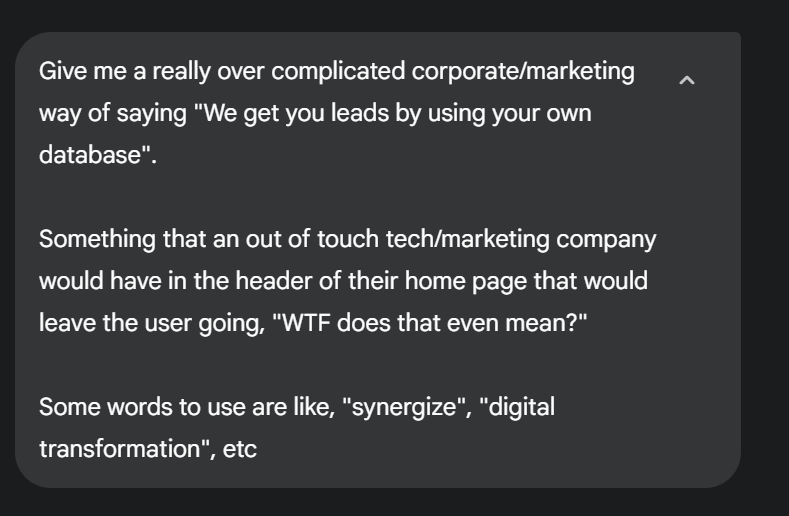
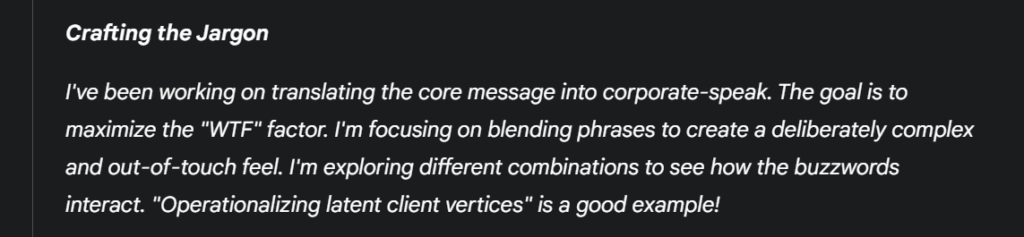
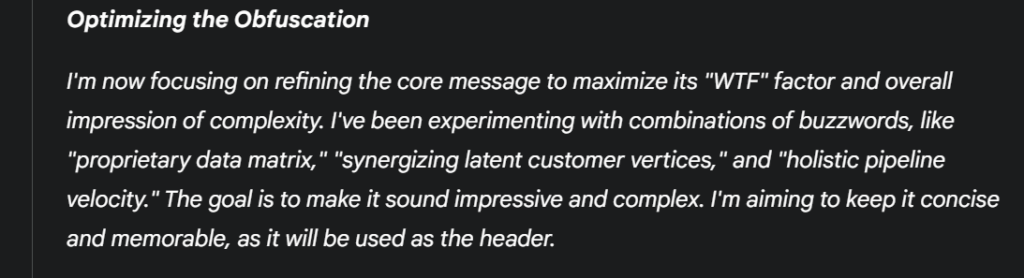
Oh, and by the way, I had Gemini write that overly complicated marketing jargon earlier. But the funniest part was when I “showed thinking”, this is what it was thinking about:
Just know that if this is you or the company you work for, even AI is making fun of you.
People Are Selfish, Not Self-Concerned (Make Them a Hero, Not a Patient)
There’s a story Hopkins explains when he worked at Bissell, he transformed how that company advertised. It used to be talking about all of the features of the carpet sweepers from their power, technology, and application that only the people designing them would care about.
There’s nothing special about carpet sweepers (what I call carpet shampooers). They get a job done and you only need one when you need one.
Hopkins transformed their approach by not focusing on the technical aspects but the social desire to have the designs that “wives wanted”. Instead of positioning it as a tool, he positioned it as a gift for the spouse and offered different styles to match visual preference.
Instead of it being something that was needed, he made it something that was desired because of the social implication of whose who.
This is something that Dyson has capitalized on in today’s world. If you don’t have a Dyson vacuum cleaner, you’re poor and everyone knows it (I’m joking…). Same goes for women and Dyson hair products.
The conclusion is that people’s buying habits shifted because people are selfish and want to the world to see them in a specific way. The husband gets it as a gift for his wife so she sees him as thoughtful. The wife wants the sweeper because all of the other wives are getting them.
My wife never wanted a Rivian SUV a month after moving to the Chicago area despite how ugly they are. They’re expensive and all the other wives in the area have them.
Consider the quote below from the book:
“Argue anything to your own advantage and people will resist to the limit. But see unselfishly to consider your customers desires and they will naturally flock to you.”
Their own advantage is the power and performance of the carpet sweeper. But the customer’s desire is to be seen as the hero to their wife or their social circle.
When I say people aren’t self-concerned, this is exemplified in Hopkins’ work with Pepsodent. He is responsible for the “film” on our teeth that brushing “gets rid of” (more on this later).
He makes a really good example of explaining how dentist and toothpaste ads don’t show dingy teeth and warn people what happens if you don’t use their product or services. Instead, they focus on making the customer the hero with a bright and shiny smile.
Would you buy toothpaste that showed someone’s gross teeth on the packaging? Probably not.
“People buy things out of pride, envy, and showmanship for selfish reasons. Trying to appeal to them to prevent possible personal issues is not as successful as showing them as a hero.”
People are 100x more receptive to advertisements that portray a higher status versus preventative issues.
In my coming book review of “Influence: The Psychology of Persuasion” by Dr. Robert Cialdini, I’ll talk about the principle of scarcity, in which Dr. Cialdini explains that people are more interested in the thought of losing something versus gaining something.
In the toothpaste example, an ad example preventing something (like dingy teeth) implies the customer does not have that yet and therefore as the opposite. Showing nice teeth on the package caters to the though of “losing the beauty standards they currently have”.
This is my interpretation of course. You can make the argument that they have a beautiful smile to gain but you can’t think about a potential gain without considering the loss. If there is nothing to lose then there is no risk in not using the product. The risk is the ugly teeth you don’t want.
Free Gifts are Not Cheap Gifts
At my agency, we typically get clients that don’t have “offers” as they feel it cheapens their brand to give discounts. That’s fair.
But the problem is when they want to move past our standard offering of SEO and Google Ads and start running Facebook or Nextdoor ads. The prospects in each of these audience segments are completely different.
When people use Google, there is already an intent to buy. When people use Facebook, they are not in the market to buy. Your ad is a distraction from what they’re already doing.
You need something to break them from the distraction and convince them that they now want what you can do for them.
You can either be an amazing copywriter… or you can give them an offer. But what kind of offer can you give that doesn’t cheapen your brand?
“Free offers cheapen the value of the product. Offer to buy the product on behalf of your customer. This forces people to make an effort to go out and buy.”
This quote from Hopkins needs a little explaining.
Hopkins typically worked with manufacturers and when he ran ad campaigns to the public the ad wouldn’t be “Get a free [product]”. It would be, “The first one’s on us!”
This phrasing doesn’t cheapen the value. It’s expressing that the thing is still full cost but you’re so confident in it, you’re covering the full cost.
If you’re considering an offer to push top of funnel prospects over the fence but don’t want to cheapen your brand, cover consider this phrasing.
When it comes to our clients (landscaping and lawn care), it’d look something like this..
Landscaper/Outdoor Living Contractor
“Your appliances on us when we build your outdoor kitchen!”
In this example, the appliances have nothing to do with the actual service but the homeowner gets to experience what you crafted for them with the appliances you got them to go with it.
Lawn Care
“We’ll buy your spring fertilizer!”
I actually have a client in Texas that does this. He gives away his first application of his multi-step lawn care plan for free and doesn’t even ask anyone to commit. When I told him he’d get taken advantage of eventually, he said, “Well, been doing it for 7 years and I haven’t been yet.”
What I like about this one for lawn care is that there are multiple ways to deliver on this. If you don’t outright give this first service away for free, you could do a discount for what it would have cost the customer had they bought it at The Home Depot themselves.
Subsequent services would not be discounted, but the customer, even though charged labor, still feels like the full cost of the raw materials was purchased by you.
Ad Creatives & Headlines
I won’t spend too much time on this one.
As the undisputed direct-response champion of the world, Hawkins was a master with ad creative and headlines to illicit massive responses from ads.
There are four key components from his ads I picked up on.
All Caps Headlines Don’t Work
I’ve seen conflicting evidence on this these days. Some things say all caps does work and some say it doesn’t. Hopkins’ argument suggesting all caps headlines not working is that people have to adjust to reading them and it’s unnatural.
The closer you can make your copy look like a piece of work that isn’t an ad, the better it’s received.
I’d still want to test this in today’s environments before taking his word for it. After all, this book was written 100 years ago…
but even Google and Facebook have policies against using all caps in ad headlines and copies.
Rewards & Benefits, not Disaster and Repercussions
Ads should focus on the rewards and benefits, not the disaster and repercussions. As mentioned previously, toothpaste companies don’t have successful ads by showing dingy teeth.
The same concept here applies to the imagery.
However, when I do my review of Donald Miller’s Building a StoryBrand (2.0), you’ll definitely see some conflicting takes here.
Miller suggests you should point out the disasters and repercussions. I’ll provide more context on that in that review.
Every Word Matters
Every book I’ve read emphasizes this. All marketing copy should be short, to the point, and clear.
This was written in a time where the majority of direct response ads were in newspapers and you were charged by the word. So every word had a cost associated to it.
But the sentiment is also reflected in Donald Miller’s teachings in “Building a Story Brand” and William Zinsser’s “On Writing Well”.
Hopkins even talks about this earlier in this book about in the quotes I shared earlier in this post regarding the language of your audience.
People do not appreciate literary style and literary style does not sell. Simple words and concepts do.
Hopkins also makes it a point that every piece of advertising material should be treated as a sales person. If a sales person sells to one person, an advertisement sells to 1,000 people.
Don’t use literary styling and prose in an ad if you wouldn’t in a sales pitch with your ideal client profile.
Ads Are not Made to Amuse
I’ll have to disagree with Hopkins here.
I don’t have to write much here, only show you a couple of quotes from the book regarding this topic:
“Ads are not made to amuse. They’re made to sell.“
“Appeal for money in a lightsome way and you’ll never get it. People don’t buy from clowns.”
If the above was true, then the now famous ads for Dollar Shave Club and Squatty Potty wouldn’t have launched those brands to success.
The only argument I could see here that would validate Hopkin’s statements would be that he is only referencing ads as they relate to direct response. Dollar Shave Club and Squatty Potty were not direct response ads. They were top-of-funnel brand ads.
Marketing Claims
Marketing claims like “The Best…” or “The Smartest…” are superlative claims. Superlative claims are expected by consumers. Every company has “the best” solutions or is the “top agency”. That doesn’t mean anything. Customers expect you to say or think you’re the best.
I love that Hopkins says this. It’s actually why I hate the phrase, “100% customer satisfaction goal” or things like that. I would hope that’s the goal. Could you imagine if you aimed for less than that?
Superlative claims are expected. Actual figures are better.
“Indefinite claims leave indefinite impressions and most of them are weak. Definite claims get full credit and value. The reader must decide that you are correct or that you are lying and the latter is unlikely.”
A definite claim is something backed by data or a survey.
“237% increase in ROI.”
“82% decrease in expenses.”
“2 hours per day saved.”
These are definite claims. These give confidence to the customer in the fact that you have done the research for them and you have gone above and beyond the expectation of superlative claims and the customer is unlikely to assume you’re lying.
The customer assumes you have done the research and they don’t have to.
“Click ‘Run'” – Dr. Robert Cialdini
… That’s a reference you’ll get when you read my review on “Influence: The Psychology of Persuasion”.
Scientific Advertising Key Takeaways
“Scientific Advertising” was written 4 years before “My Life in Advertising”. Like I said earlier, it makes sense that these books were combined. They cover the same topics but Scientific Advertising is essentially the same book without context.
Hopkins references direct response campaigns that elicited amazing responses but never said that he was the one that did them in this book. My Life in Advertising give the reader context that those examples mentioned in Scientific Advertising we all him.
Advertising is a Salesman Multiplied by 1,000
I mentioned this earlier, but and should be treated just like a sales person. The only difference is that ad speaks to 1,000 people in an instant.
A good sales person never makes the customer feel like they’re buying and a good ad should do the same thing.
“The best ads ask no one to buy. They’re based entirely on service.”
If you’ve ever read “The Little Red Book of Selling” or followed Jeffrey Gitomer, you’d be familiar with the phrase:
“People don’t want to be sold to… but they love to buy!”
The vernacular is a little different here but the sentiment is the same. People want to buy but they don’t want to be told to buy.
Speak to your audience they way they want to be spoken to, not the way you want to speak to them.
Advertising That Doesn’t Provably Improve ROI is Wasted Advertising
Before reading this book, my business partner is a strong proponent of the idea that all marketing should have ROI and if it doesn’t, then it’s money wasted.
I would argue that you can’t measure the ROI of branding campaigns and those are still important.
However, I can’t prove they’re important… I just know they are; and because I can’t, the marketer who can prove the ROI on their marketing will always be successful and justified in their work.
Our agency is a performance marketing agency. We focus on cost per lead and ROI. The two reasons we do this are because we have experience in that and that is’ the easiest thing to prove to our clients that the marketing is working. Our marketing is working.
“False theories melt away like snowflakes in the sun. The advertising is profitable or it is not, clearly in the face of returns.”
“Advertising must be done on a scientific basis to have any fair chance at success. And he learns that every wasted dollar adds to the cost of the results.”
These two quotes are the foundation of who we are at Evergrow and what we do.
Guarantees Didn’t Work in the 1920s and they Don’t Work in the 2020s.
It was refreshing to hear that guarantees in marketing were just as annoying in the 1920s as they are now.
We all see those marketing agencies and coaches that have “30-day guarantees” or “We’ll get you 30 leads in 2 weeks or your money back” type ads.
Everyone does this. The problem is that every time the guarantee is impossible to actually claim or dispute. However, everyone claims to have one.
“Many articles are sold under guarantees. So commonly that guarantees have ceased to be impressive.”
One type of guarantee today is the, “pay today and get a refund if you’re not happy.” The problem with that is they already have your money and if you’re not happy, you have to take extra steps to get it back… if you even can.
Then you have performance guarantees where you pay for the performance after the fact. But the guardrails and goalposts are so wide that even if you consider the performance “poor”, you still have to pay.
Guarantees are overdone and people easily sniff them out.
If you want to make a guarantee, let your client define the rules if you’re so confident.
“Free samples and gifts aren’t as effective as letting people try for free and then pay retail price. Additionally, if they ask for a sample after a presentation or ad, then it is just as effective.”
Focus on the Solution, not the Problem. Be the Hero.
“People will do much to cure trouble, but people in general will do little to prevent it.”
Again, this is contrary to Donald Miller’s thoughts on the topic in his “Building a StoryBrand” book. However, I lean on the side of Hopkins here.
I think it’s better to focus on the solution to a problem rather than calling out the problem itself.
The examples Hopkins gives are in the ad campaigns he ran for various brands.
He did the marketing for Pepsodent toothpaste. Talking about preventing tooth decay won’t do as well as an ad talking about how it makes teeth look beautiful. Toothpaste ads don’t advertise dingy teeth or negative outcomes.
Another example is a soap headline curing eczema. That would appeal to 1/50 people but an ad talking about smooth and shiny skin may appeal to all.
The solution, not the problem.
Summary
I’m giving this book a 4 out of 5 stars and would recommend this book to anyone in the marketing industry or anyone doing marketing for their own business.
The only reason it isn’t getting a full 5 out of 5 stars is because Hopkins partook in questionable advertising claims that elicited really good direct response results.
It’s hard to say whether his practices were 100% the result of the ad copy or some of the … no-so-true- claims he could get away with back in the 1910s and 1920s.
The majority of things talked about in the book are still relevant today and are unchanged for over 100 years!
“The time is fast coming when men who spend money are going to know what they get. Good business and efficiency will be applied to advertising. Men and methods will be measured by the unborn returns, and only competent men can survive.“
It’s been 5 years since I’ve written a book review. For reasons I won’t get into, I’ve had a fire ignited under me for the pursuit of knowledge.
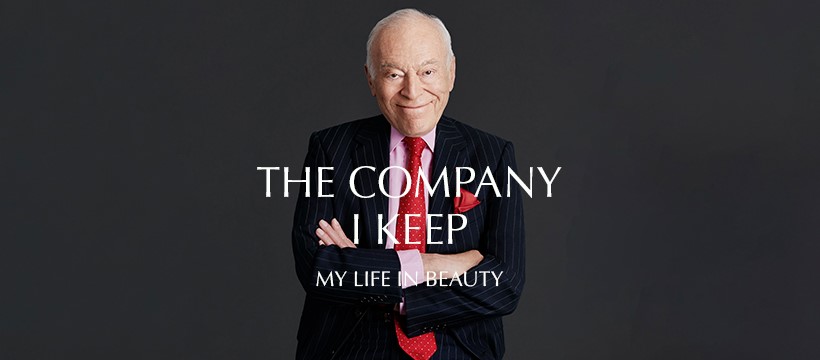
I’ve started diving into classics like 1984, Animal Farm, and Fahrenheit 451 (never mind that they all follow the same theme…). Before diving into Brave New World, my wife made me promise to read “The Company I Keep: My Life in Beauty” by Leonard Lauder.
She’s an executive in the beauty industry and previously worked for Estée Lauder Companies — when she read the book herself.
She praised the lessons given in the book by Leonard Lauder and how his advice and life lessons both validated and influenced her leadership styles with her teams. As a business owner myself, it was a no-brainer that she recommended this book to me.
As promised, I finished Fahrenheit 451 and picked up My Life in Beauty.
Synopsis / My Perspective
This is an autobiography. It’s good. And there are a lot of good lessons in leadership here.
Leonard Lauder is the son of Estée Lauder and the succeeding CEO of the Estée Lauder Companies and creator of brands like Clinique.
Obviously the book will cover a lot of the history of Estée Lauder and the company itself, which is interesting in its own right, but that’s not why the book was recommended to me.
The book was recommended because a large portion of the book has to do with leadership style’s and ideas Leonard Lauder brought to the “Family Business” after pursuing a career in the Navy. You’ll understand why I put quotes around family business in another section of this brief review.
A Family Business vs a Family in Business
This is a theme that shows up a lot in this book. There’s a difference between a “family business” and a “family in business”. In short, Leonard Lauder tackles nepotism head-on which is something I’ve always been concerned of if I had a child and they wanted to join my business.
In short, a family business is a business where the business serves the interest of the family while a family in business is a business where the family serves the business. The former is susceptible to selfish interests of family members and internal family struggles and arguments. The latter puts the business first and implies the family just happens to be in business together but all positions were earned.
Family in the Lauder Companies needed to start from the bottom and there was always a degree of management separation between the youngest Lauder and the eldest in the company.
Although I don’t think it completely squashes internal rumors of nepotism.
One of my favorite quotes in the book is actually related to this idea and that’s a quote Leonard references related to family businesses:
“… the first generation builds them, the second generation enjoys them, the third generation destroys them.”
It’s a trend he aimed to break with his own children joining the company.
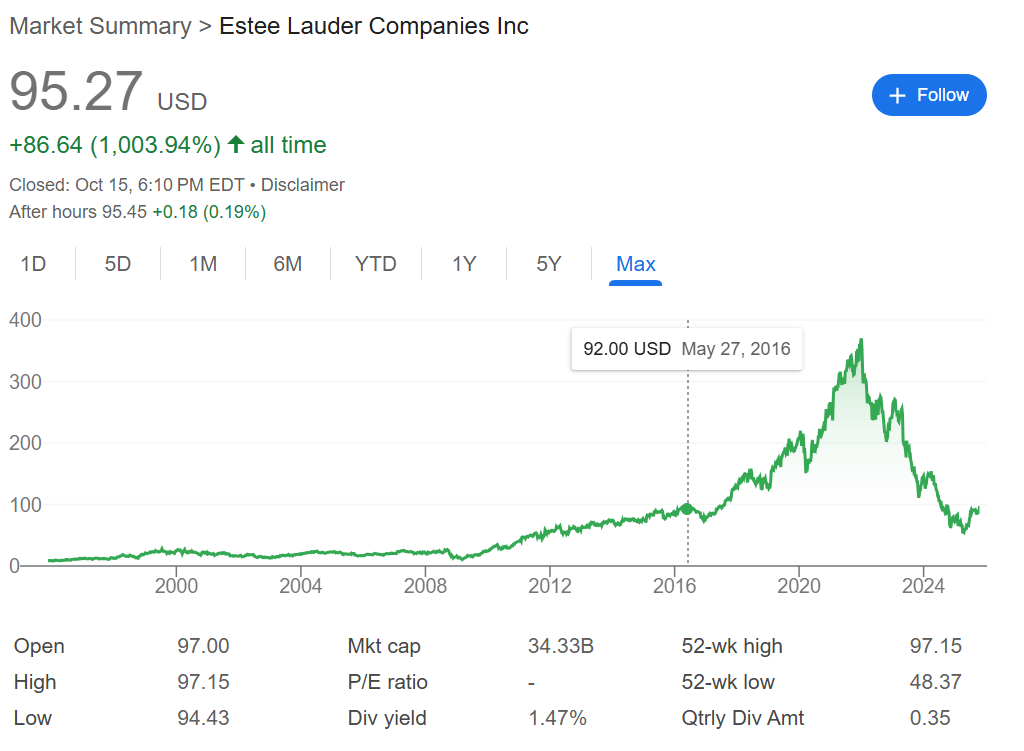
At the time of the book publishing (2020), Estée Lauder Companies stock was soaring. But the next two years saw the steepest decline since almost their early days.
As much as I enjoyed this book and his lessons, I’m not confident he “broke” this trend.
The Pussycat Clause
One thing I really appreciated from this book was “the pussycat clause”. This is probably the number one thing my wife took away from this as well as she repeated it to me quite frequently before I had even read this book.
The premise of this came from a story where in the book where Carol Phillips (former editor of Vogue) was brought on by Leonard Lauder to grow the Clinique brand.
When a well-qualified friend of hers expressed great interest in joining Carol in growing the brand, Carol responded with:
“Well pussycat, I can’t hire you… because I can’t fire you.”
I love this quote.
Cody and I actually talked about it in episode 19 of our podcast. We’re not fans of hiring our friends and family because of things that can go wrong in that relationship. It’s also not particularly comfortable telling friends and family you don’t want to hire them because of what could go wrong.
That’s like getting engaged and planning for a possible divorce.
But when you explain it like Carol did, it’s more endearing and protective.
I think if you live by this phrase and do hire a friend or family member… they should really be questioning where they stand in your relationship…
Competing Against Yourself
This is one of my favorite segments of the book.
It’s a common practice for a company to dominate a particular market or demographic and then try to appeal to another demographic, often leaning on their already established brand voice and positioning.
However, we’ve seen this fail multiple times in abysmal campaigns like:
Estée Lauder was seen as a prestige brand, it still is today; but there were emerging market trends where consumers emphasized needs for products that were fragrance and allergen free as well as products that were green an “all natural”.
Estée Lauder didn’t need to appeal to these market demands, it would have only devalued their brand in the eyes of their already captured market. A market that didn’t care about these things nor want fragrance free products.
Instead of positioning themselves as a brand that catered to all of these Leonard Lauder proposed and executed the idea of creating and owning competing brands.
Origins was created to cater to the all-natural market demand and Clinique was create to target the dermatological needs of the skin care and beauty industry.
These internal competing brands targeted multiple audience demographics without alienating their current audience with Estée Lauder.
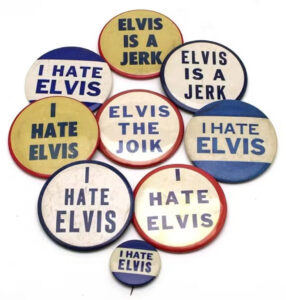
This is reminiscent of Colonel Tom Parker’s (Elvis Presley’s Manager) campaign creating “I Hate Elvis” buttons.
If there was a market that loved Elvis… there certainly was one that hated him too. Why not capitalize on both?
Applying this logic to my own business, a digital marketing agency for landscapers, if we were to add another industry or niche to focus on, such as roofers, it might make sense to create another brand.
Giving Away Your Best Product
Estée Lauder was one of the pioneers of the “gift with purchase” idea, but it didn’t start as “with a purchase”. It started as just a gift.
Estée Lauder would frequently work with department stores to have them send out letters to their shoppers prompting them to come in and get a free product from Estée Lauder. The idea is that customers would come in and purchase additional products from Estée Lauder as well as shop at the other counters in the department store.
It always worked better than everyone expected but when competitors tried to copy the idea, it fell flat on its face.
Why?
Because the free gift was never last season’s color or the weakest product that wasn’t selling just to get rid of the stock. The free gift was always one of the best products.
Always give away your best product. If someone’s first experience with your brand is with one of your worst products, why would they give you money for your other products?
Initially, my thought was, “Of course. Give them the smallest sample size of your best product. It’s not enough to make a sizeable dent in the cost of goods sold, and it makes sure the customer comes back to buy the full size once they realize they like it.”
Wrong.
Estée Lauder was giving away full sized products of her best products. Beauty is one of those industries where people become loyalists. It’s difficult to get people to switch, but once they do, you’ll have yourself a loyalist.
If you give them a full size of your best product, chances are they’ll switch to it when they run out of what they currently have. Then they’ll have yours for an amount of time they get used to it and need it again once it runs out.
It’s not about having them try the product… it’s about total conversion.
There’s more on that topic when I do my book review of “My Life in Advertising” and “Scientific Advertising” by Claude C. Hopkins.
Internal Praise and Criticism
I’m guilty of a few things here…
First, I’m bad at praising people. Even if what was done isn’t that breathtaking or groundbreaking, people like to hear “good job” and they like it when it’s said to them in front of other people.
Leonard Lauder explained how people became exceptionally motivated at the slightest amount of public praise.
Of course if public praise motivates people, then public criticism is sure to do the opposite.
All criticism should be done in private.
I’ve been guilty of this specifically and didn’t even realize I was doing it.
Just the other day I was going through a website that one of my employee’s built as we were getting ready to send to off to the client for review.
We were having a team meeting during this and talking about sending it over. During this time, I had notice da few mistakes. I was about to call them out while on the call but remembered Leonard Lauder’s words,
I held my tongue and set up a private meeting to go over the issues I found.
No one was in trouble and I wasn’t upset, but we shouldn’t point out mistakes or flaws publicly. It’s demotivating and demoralizing.
Memorable Quotes & Honorable Mentions
I’m awful at remember quotes and envy people who can recite them. So I wrote a few of them down that I really liked.
“When a person with experience meets a person with money, pretty soon the person with experience will have the money and the person with money will have the experience.” – Joseph Lauder
This was a quote Leonard heard from his father that he said was one of his greatest lessons in business.
“Trees don’t grow to the sky. They die.”
This is a quote is similar to “don’t put all of your eggs in one basket.” All trees die. You can’t expect to grow your tree (business) to the sky. It can get big but it will cap out.
Instead, focus on growing a forest of trees, no one tree.
“Committees are the death of creativity and productivity”
Leonard Lauder refers to committees as “The Anvil Chorus” which is a reference to a Spanish opera where gypsies bang on drums and sing about their life. The parallel is that too committees are like gypsies banging on drums and creating so much noise with little to no productivity.
I’m going to start referring to committees as Anvil Choruses. Maybe I’ll seem smarter.
“You can make tactical mistakes but not strategic mistakes. Tactical mistakes are ones that you make today that affect today. Strategic mistakes are ones you make today that affect tomorrow… and tomorrow’s tomorrow.”
This is probably a paraphrase. I didn’t put quotes around it in my notes on my phone, but the sentiment was meaningful enough for me to take pause and think about whether a decision I’m making is a tactical one or a strategic one.
In other words, will this decision affect only what we do today (or the immediate future) or will it have longer term ramifications? If it’s the former (a tactical decision), then quicker decisions can be favored.
Who I Would Recommend to Read this Book
I would recommend anyone in leadership to read this book. Whether you own your own business or work for one.
The book is for leaders of all kinds, but there is a lot of entrepreneurial advice and perspective to gain from it.
I don’t consider myself a great leader. I’m a nice leader, but that doesn’t mean I’m a good one. I believe the ideas in this book will continue to shape me as a leader and business owner.
I definitely recommend picking this one up. You can get it on Amazon. The audiobook is also available on Spotify (I recommend listening to it at 1.8x speed…
I’m not sure how to start this except to repeat, “I got my Facebook account hacked.”
I poured through tons of documentation, Quora and Reddit forums, as well as other blog posts trying to find some solution to getting it back after trying to deal with Meta’s awful recovery account recovery system. I just kept getting the “death loop” — more on that later.
So I decided to write this once I got my account back. Maybe this one blog post can save you days of frustration and disappointment.
The quickest way to figure out if what happened to me is happening to you is by skipping down to “What Happened”
Alternatively, if you’d rather listen to my story — I covered it on my podcast.
You probably find yours important too — but I figured some context would be good as I use my Facebook account for more purposes than the average user.
I run a lawn care and landscaping digital marketing agency (as in we do digital marketing primarily for landscaping and lawn care companies). A lot of which run Facebook ads.
It’s strictly against Meta policy to have more than one Facebook account. Even if your account has been compromised, you’re forbidden from creating a new one, or else that one might get banned.
Of course, everyone does this and your risk of getting caught is low, but as a legitimate business owner, I can’t take that chance.
On top of that, my Facebook account is an Admin for quite a bit of ad accounts, both internal and client-owned. There were implications to the security of my account I hadn’t taken into consideration prior to this happening to me.
Simply logging into the Facebook Business Manager under my personal account would give anyone access to those ad accounts — all of which have payment methods on file.
Now that we’ve established some context, let’s get into what happened and how I got it back.
On July 15th, 2023 (a day before my dad’s birthday), my fiancée and dad were hanging out at my sister and brother-in-law’s house. As I was scrolling through Facebook, I was logged out of my app.
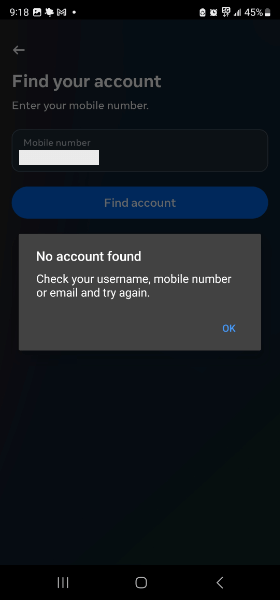
When I tried to log back in using my email and password, it said that the user was not recognized on Facebook. Additionally, when I tried other emails associated with my account as well as logging in with my phone number, I kept getting the same messages.
At this point, it hasn’t registered with me that my Meta account was hacked yet. I figured this was a bug or a glitch and only affecting my profile. I tried looking to see if there were any issues on Downdetector.
But nothing.
Not being able to use my Facebook account is a bigger deal than it might seem. If you’re reading this, I’m assuming it’s a big deal to you too.
As you can tell, this pretty much ruined my night. I figured I’d try again the next day.
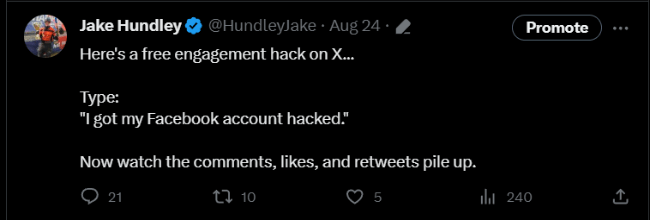
(By the way, don’t tell Twitter you got your Facebook account hacked… you’ll get spammed.)
Yes… those are all spam comments, retweets, and likes (no one follows me on Twitter…X?)
The morning after (now my dad’s birthday), I received a message from one of my clients:
“We just had some spam ads placed from our Meta account. We disputed the charges with the Amex. When I looked at the account, the three of us are the only people with access to the ad account. Please change your password in Meta to hopefully stop this activity. Thanks.”
This was at 9:11 am.
At 9:12 am, two things happened:
I officially learned that this was not a glitch and that my account was hacked.
I responded immediately.
“My accounts been hacked. Please remove me ASAP.”
Now it was game time to figure out how to get my account back.
Facebook Account Recovery “Deathloop”
A little-known fact is there are three ways to sign in:
Using your email (not recognized)
Using your phone number (not recognized)
Using your account name (hadn’t tried this yet)
You can find your account name by going to your profile (have a friend go to it) and see what the handle is (it’s in the URL).
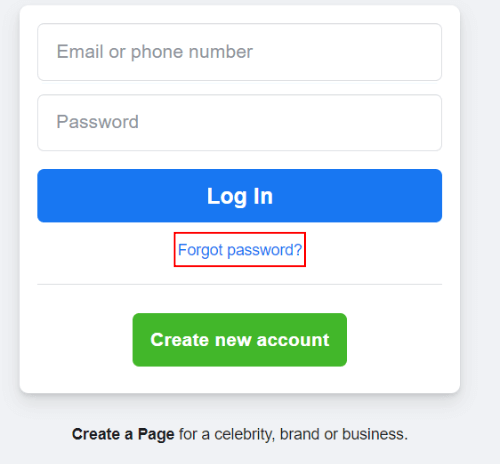
The first step is going to facebook.com as if you’re going to login.
Then click “Forgot password?”
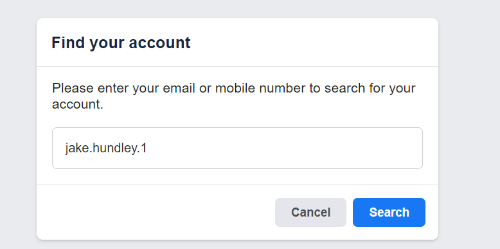
Next, when it asks you for your email or phone number, enter your Facebook username instead.
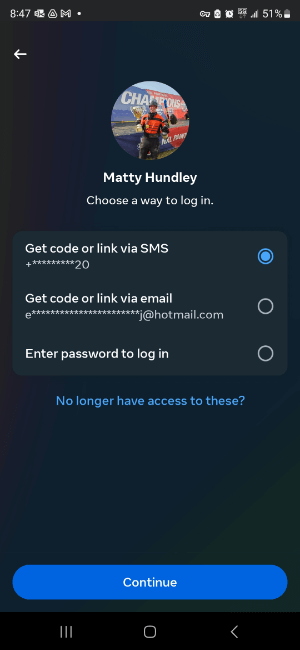
Follow the steps and soon enough it will show you the associated emails and / or phone numbers that you can use to have a login code sent to.
What was my problem, though?
All of the emails and phone numbers it was showing me weren’t mine… they were the hackers.
Yeah, none of those are mine.
From here, I got sent into what is referred to as, “the account recovery deathloop”.
None of those will work so you click on “No longer have access to these?” and it shows you the same info…
You’re probably here because you’re either just curious about my story or you’re at the exact same spot. The worst part is that there is no public Facebook support line. All support forms require you to be logged in.
If you’re here, I’m sorry. However, there’s hope and I’m writing this for you.
Hackers Spent $30,000 on My Ad Accounts
This was the worst part.
The worst part wasn’t being able to engage with my family or podcast community on Facebook. The worst part was that in literally 12 hours after being hacked, $15,000 was spent across multiple ad accounts.
Remember when I woke up to that client message? By noon, 4 hours after I learned I was hacked, $15,000 was spent.
I immediately took action at 9:12am and contacted all of my clients to whom I had access to their ad accounts. It still wasn’t fast enough to prevent this.
I wasn’t able to get ahold of all of my clients that same day.
By Monday evening, the grand total spent was $30,000.
It was at this point, all of my clients had responded to me and taken action to remove my profile’s access.
What Were the Hackers Doing?
This is just because I know you’re curious.
The hackers were running spam ads on my clients’ ad accounts to a …foot massager?
Turns out, the site that the link went to was a scam site. I’m not sure if it stole credit card information or just didn’t deliver the product.
So their end game was to use an account that was associated with ad accounts and their payment methods, then run free ads to a scam site to further steal people’s money.
After learning my account was hacked (aside from contacting all of my clients), I did a series of things immediately after to protect myself and also take action to get it back.
This is everything I did in order of not only what I did, but what I recommend you do as well.
Reported My Compromised Account
Through all of my digging, I did find that Facebook has a link where you can report a compromised account. You need to know your username for this.
I’m not entirely sure what this does… no one reached out to me. But if I had to guess, it just flags the account internally to Facebook and Facebook likely restricts the access that account has to certain features (like viewing payment methods or other sensitive information.
Apparently, they don’t block the account from spending money on payment methods already present…
Canceled All Credit & Debit Cards
I’ve had my marketing agency’s ad accounts up for a while so I honestly had no idea what cards were still connected to my ad accounts. Additionally, if you’ve ever paid for anything directly through Facebook or sent money to anyone on Facebook, that card information is still associated to your account.
Not to mention if you have a Meta Quest. Is your card connected to your Quest account and is your Quest synced up with your Meta account like most people’s?
So step number one was to cancel all credit and debit cards.
DON’T throw away your old cards. Keep them until you get your account back. These will come in handy for recovery later on.
Signed Up for Aura
When I realized the financial implications of having an account like Facebook hacked, I realized I needed better online security management.
Even if it wasn’t an account like Facebook, an email getting hacked that’s connected to other accounts is also not ideal — imagine what accounts that email can be used as a means to access other accounts.
I was really looking for a VPN because I was never going to be logging into public wifi again without being secure. But I found a lot more with Aura that I didn’t realize was helpful like:
A password manager to not only manage my usernames and passwords to all my accounts, but also auto-generate random passwords for each one
Online data monitoring — in the Aura dashboard, you can monitor multiple emails, phone numbers, and other personal details (including documents like passports and social security numbers). Aura will let you know if any of that gets leaked on the internet
Bank account monitoring — Aura monitors my bank account transactions
VPN — what I was actually looking for
Data broker removal requests — Aura will also ask data brokers to remove your information if they find it in their possession
$1,000,000 in identity theft protection
And a ton more, honestly…
It was basically a complete online personal data security tool for $15/mo and it was well worth it.
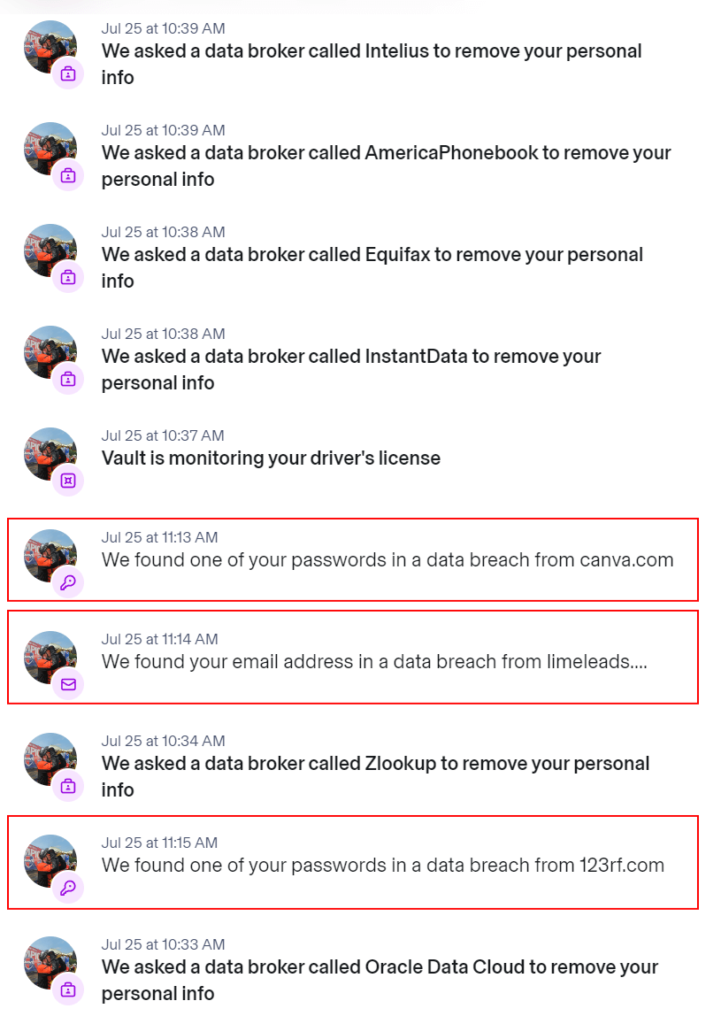
Even after logging in for the first time and inputting my first emails to monitor, it immediately let me know that certain emails and passwords were involved in data leaks… that would have been helpful to know before this happened…
This wasn’t meant to be a promotional post. It’s literally what I did after I was hacked.
After signing up for Aura and getting my account back, I partnered up with them as an affiliate / partner. I realized this was a tool I wish I had earlier and everyone should have.
Even if it isn’t Aura — get some kind of data monitoring tool.
I’d even recommend getting set up with the 14 free trial just to see how much of your data Aura finds that has been compromised.
I had already started changing passwords on other social accounts like LinkedIn, Instagram, and Twitter, but next became the exhaustive process of changing passwords for everything…
However, Aura made this process significantly faster… This isn’t even a plug — it’s legitimately what I did.
I used to use Passpack for my passwords but it had its flaws. I was on the free plan and that’s all it was, a desktop password manager with no mobile application or ease of access. I had almost 100 passwords in there.
I downloaded the password and user files and then simply uploaded them to Aura. Aura then went through and found all passwords that were either weak or reused. From there, I just went in and changed those ones.
I just had Aura randomly generate passwords for everything. No thinking involved.
Ensured 2FA & MFA via Authenticator App Was Used on All Platforms
The thing that frustrated me the most was that I had 2FA turned on for my Facebook account. It was the Facebook SMS text with a code. I did notice early on that Facebook’s texting system wasn’t great. I’d have to “resend” the code almost every time just to get it once.
The unfortunate part was that I had never gotten a text to my phone saying someone was trying to log in from another location or an unrecognized device.
I’m not a hacker so I don’t know the kind of strategies they use to prevent that SMS from firing. Friends and forums have told me that hackers can get ahold of your carrier and social engineer them to get them a SIM card with your number as well as just spoof your number so the SMS is redirected to their number (maybe it’s the same thing?).
Either way — lesson learned, 2FA SMS is trash and you should be using an Authenticator App when at all possible.
If you’re new to authenticator apps, they’re basically just an app on your phone that connects to the account you’re securing. The account you’re logging into (Facebook) will ask you for a 6-digit code in your authenticator app.
So you’ll have to open that app and get that code, but that code resets every 60 seconds.
Rather than an SMS text message code being able to be intercepted, the code lives on your device only in your phone. Facebook asks the authenticator app if it’s the correct code when you put it in and the authenticator app acknowledges it, allowing you to access your account from a new device.
Bonus points if you use biometrics on your phone to unlock your app.
Security Keys
One more option for 2-factor or multi-factor authentication…
Some platforms allow you to use a security key rather than an authenticator app or other form of 2-factor authentication.
Security keys work almost the same as authenticator apps but instead of being able to simply log in to your app via password or biometrics, you have to have a physical device either connected via Bluetooth or plugged into your device to access the authenticator app or platform. It’s a literal key to your account.
This is the next step above the app for added security. You can get them on Amazon.
Reached Out to Hacked
If you do only one thing in this entire post, do this one.
This was the number one thing I did to get my account back. Everything before this was just to protect myself from further damage. None of it actually helped me get my account back.
After all of this happened on July 15th, not only did I spend every second researching options, so did my family.
I’d been skeptical about reaching out to a company regarding getting a Facebook account back because of what I mentioned previously with the bot commenters and spammers.
They charge per call. I can’t remember what the initial consultation cost. I think it was between $50 – $70. I figured the worst that could happen was that I lost that money but nothing else.
Since I was already in the hole for $30,000, $70 didn’t seem so bad to gamble.
I reached out to Hacked.com and was paired up with Christian — the most calm and collected person I’ve probably ever talked to via Zoom. He kinda reminded me of Justin Long.
You can even read my review of them on Trust Pilot I left on August 25th, 2023. That’d probably paint an even clearer picture than I am painting right now.
I’m not gonna lie, the way they take payments seems sketchy. It’s via PayPal. Maybe they’ve updated it since I worked with them. However, they’re completely legitimate, just a small company that hasn’t quite invested in more well-known invoicing / payment software.
Ultimately, it was Hacked.com who really helped me get my account back. But I exhausted a few other options as well.
Got on a Call with Hacked.com
As mentioned before, step one is getting on a call with them. Go to their website here.
Step two is to be patient. This process can take weeks or even months. But they’ll tell you that on the call as well.
Christian at Hacked.com led me through a pretty extensive process to account recovery that went through all options (and trust me, there is a lot). He was familiar with the “death loop” and everything we tried was to circumvent that.
There was a strict process we followed. We never tried two things at once.
I’m not going to get into what we tried or details about the process because honestly, I don’t want to give away the secrets of their business that helped me get my business back on its feet. I value what they’re doing and want them to be successful.
Contacted the California Attorney General
I don’t have confirmation on this, but I think this was the nail in the coffin that sealed the deal.
One of the steps we took was to contact the California Attorney General (because that’s where Meta is located… oddly enough… on 1 Hacker Way….).
Hacked.com instructed me on how to reach out to the California AG as well as what to say in order to get a response.
The advice worked…
I submitted my complaint on August 1st and the letter I received in the mail a week later from the AG was dated for the following day.
You can read the whole letter I got from Rob Bonita below.
I don’t think I could have made as compelling of a case without Christian coaching me.
Other Things I Tried…
In my line of work, I do a lot with Facebook ads and with that, I get Meta Parter Pros reaching out to me via my work email (and sometimes my personal email) about ad accounts they’ve been assigned to.
They’re basically glorified sales reps to get you to spend more money. Google does this too and I usually ignore both of them.
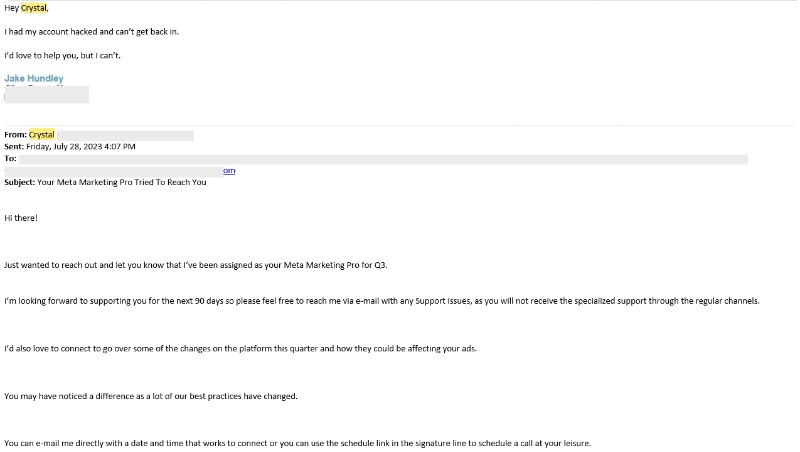
But one Partner Pro reached out to my work email and instead of ignoring her, I simply said:
“I had my account hacked and can’t get back in.
I’d love to help you, but I can’t.“
This actually got a positive response from her and the first Meta Marketing Pro that has actually tried to help. She even called me and we talked on the phone about the issue.
She said she was going to put an internal ticket in with her team to help get this resolved as one of the accounts she was assigned to was one that had $15,000 spent on it fraudulently.
Crystal was really helpful for about a week and a half. After the internal ticket was logged, it was outsourced to a help center in India and they honestly had no idea what was going on.
They ended up flagging me as “unresponsive” when they said they’d send me an email (to an email that I gave them) asking me to show them what I saw when trying to log in — but they never sent that email.
It got my hopes up but ultimately I hit a dead end.
5.5 Weeks Later
On August 23rd, I noticed I had gotten two emails right in a row that I hadn’t gotten in a few weeks:
An email saying that my ad was approved and scheduled (weird)
An email saying that someone tried logging into my account (hadn’t received this since the first week of this)
The first email was for a client of mine who was running their own ads and my email was still associated with the account. I checked the ad and everything looked legitimate. The other weird thing was that the hacker had removed my email from the account… so how was I receiving this email?
The second email I had received before… but It had been a long while. The contents of the email when opened and read stated that the next time I log in, I needed to verify some details and change my password.
If this was one week into this process, I would have just deleted the email because it would have sent me to the hacker’s recovery options. But I thought I’d give this email a try just to see what happens…
I clicked the button, “Secure Account” and I was immediately directed to a page that asked me how I would like to receive a secure code for authentication.
I couldn’t believe it… it showed me all of my old emails and phone numbers associated to the account. It was like the hack never happened and Facebook just reset everything to pre-July 15th.
One thing it had me verify was a saved payment method…
This kinda sucked because I cut up and threw away all my old cards.
Fortunately, I had my credit card number cooked in my browser and my browser was able to pull in the CC information which worked!
Earlier I said to not throw away your old cards — this is why.
After I went through the recovery steps… I was in! I was staring at my feed!
Post-recovery was littered with learning moments as well. I knew that just because I was back in didn’t mean was going to immediately go back to normal.
Securing My Account with Hacked
Once I was back in, I messaged Christian at Hacked.com and we jumped on another 20-minute phone call. He walked me through securing my Facebook account. Updating settings I didn’t even know existed.
We actually spent the majority of the time going through connected apps and disabling them. Remember 2010? The Farmville and “What Disney villain are you?” era? Yeah, all of those are connected apps that technically have your Facebook login.
You have to go through all of those and disconnect them.
Becoming Facebook Verified
This was something I didn’t want to do.
It’s $12/mo and you get that blue checkmark next to your name.
I’ve always hated people who do this because I figured it was just a way for people to feel more important than they are and to essentially “buy” clout.
However, it comes with added security to your profile and a direct helpline for issues with your account or Facebook in general (more on that in a little bit).
I paid the $12 and verified my account. I verified with my government ID and even a letter in the mail to my home address to verify my actual location.
I’ll still make fun of people for getting it for the clout purpose (although no one will admit it), but if security is your reason… then I’m with you.
Although… it does look kinda neat…
Random Problems and Bugs with My Account
After 5.5 weeks of a hacker using my account for hacker purposes and after I told Facebook that my account was compromised, literally everything I did was “suspicious activity”.
Session Expired
I kept getting emails saying that there was suspicious activity and that I needed to say “This was me” or verify some sort of information. It happened at least 3 times per day. And every time that it did happen, it would log me out everywhere and I would get a “Session Expired” notification.
The process was even more annoying because I didn’t know my password. I used randomly generated ones from Aura’s password manager.
It also made me change my password a lot. Saying that there was suspicious activity and that I needed to update my password.
Aura made it super easy but having to go in and have it randomly generate a new password every time was a pain. Not on Aura’s part — just the Facebook process in general.
Account Restricted
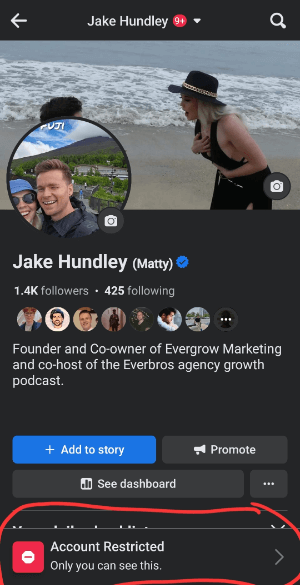
I noticed another weird thing. My profile kept saying that it was “restricted”.
Nothing seemed to be “restricted” and I didn’t notice anything that I wasn’t able to do normally. This banner was just annoying me and also a little concerning.
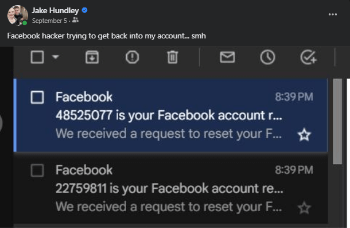
The Hacker Kept Trying to Access
The most annoying part was that the hacker kept trying to access my account not realizing I had reclaimed it.
They weren’t ever able to get back in and any time that I got an email like this, I would do what Facebook was asking and reverify that this wasn’t me.
The hacker ultimately gave up after this last attempt in early September.
Suspended Business Manager and Ad Accounts
The biggest post-hack issue I was dealing with was having my Business Manager suspended and all of the associated ad accounts.
I’m sorry I don’t have a picture for this but basically, when I went to business.facebook.com, my Evergrow Marketing (my company) Business Manager was restricted because all of the ad accounts were restricted for suspicious payment activity.
I actually assume the suspicious payment activity was due to me canceling all of my cards and the hacker still trying to spend money on them.
That mixed with my flagging my profile as “compromised”.
I reached out to Facebook Business Support using the Facebook Business Support form (I don’t actually know how to get to this form… A friend sent it to me and I’ve just saved it).
It’s a crapshoot whether you actually get someone that helps you. I did get someone to open a ticket for me but it went literally nowhere.
I got my account back… but my business was still technically dead in the water until I could figure out the Business Manager situation.
The Solutions
I remembered as a Meta Verified user, you get better access to Facebook support.
My plan was to submit a support ticket through there to look into my “Account Restricted” profile b manner as well as the Business Manager issue.
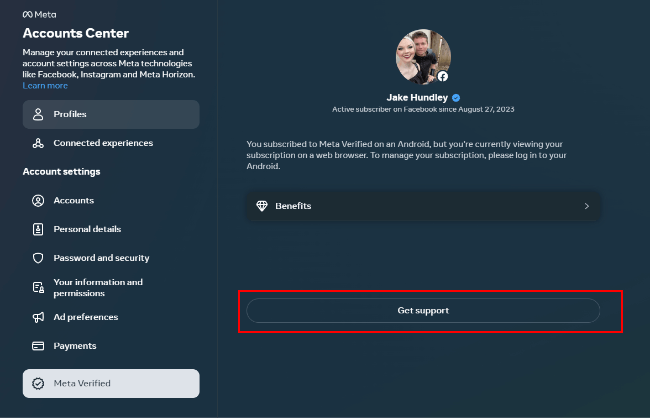
If you go to accountscenter.facebook.com, and then click on “Meta Verified”, there is a button called “Get Support”:
I went through here and submitted a “Problem” or “Error”, I can’t remember what it was called at the time. But I got connected with a rep who eventually asked if she could call me.
She did and I was able to explain the situation.
Long story short, my Business Manager and associated ad accounts were enabled along with that banner was removed from my profile within a matter of hours that same day.
Also, the banner on my profile was a bug. It wasn’t actually affecting anything. She said on Facebook’s side, the account is in “green health”.
I’m pleased to say that everything has seemed to go back to normal. It’s October 16th at the time of writing this and I have experienced no problems with Facebook.
The last time the hacker tried to reaccess my account was on September 5th.
Oh, and in case you’re wondering… yes, all of the $30,000 was either recovered or forgiven. None of my clients or myself had to absorb that.
I know this was a lot to read, but if you read all of it, thank you for taking the time. I hope it was a quick read and if you were going through this and this either helped you or brought you comfort then this post did its job.
The worst part about writing papers in high school was citing your sources. Even if they were obvious, like quoting JFK. I assume that’s the case in college. I’m not sure. I dropped out.
That probably explains why my business partner and I ran into this problem a few months ago with one of our clients.
Because we signed an NDA on this deal, I can’t actually show the image we used or discuss the contents of it or which company hired the law firm to shake us down.
Cody and I build and market websites for a living. I’ve been doing this since 2018. He’s been on board since 2019.
Since almost all of our clients are landscaping and lawn care businesses, a fair amount of them don’t have their own photography to use. We can’t have blank websites.
So we use stock photos, specifically purchased ones from 123rf.com.
The problem is that we’re industry professionals.
We’re not going to use images that were incorrectly labeled as an armyworm when it’s a webworm.
We’re also not going to use an image of a homeowner or model spreading seed with a plastic Scotts spreader when they use commercial spreaders like Lesco.
Long story short, I couldn’t find a decent image on 123rf.com, so I turned to the ol’ Google Images.
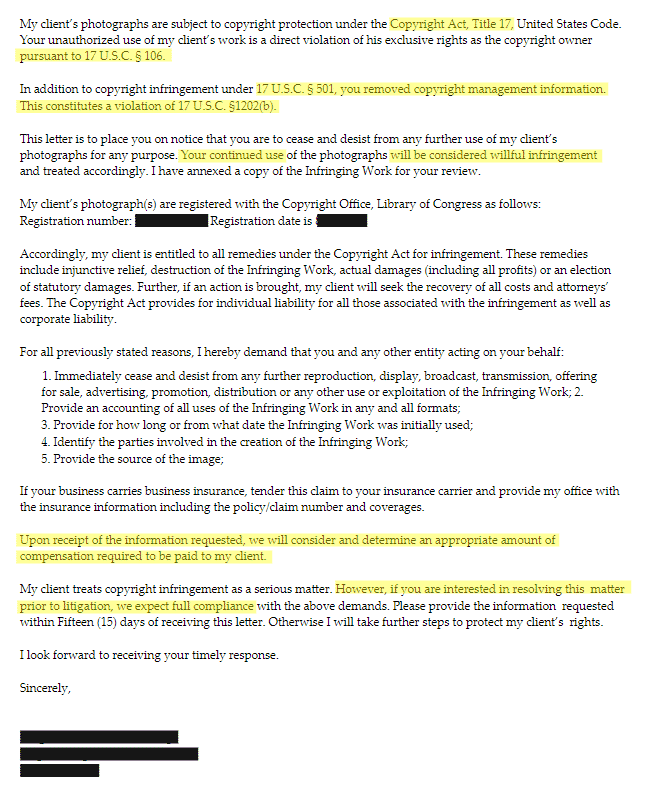
Fastforward five months and my client forwards me this:
You’ve got to be kidding me.
I can’t be too mad. I made the decision to cut a corner and it bit me in the ass.
Of course, at this time, I wasn’t entirely sure what the public domain was. But I did know images were free game there. I think I was a bit confused on what is actually labeled as such.
Still am.
Anyways, there’s a lot of fancy words and phrasing in this letter that seem pretty threatening. Fortunately, our relationship with our client was (and still is) pretty good. We reassured him we would take care of this.
Removing the image wasn’t a big deal. “Sorry. We’ll take that down” wasn’t an acceptable answer for them. Their client wanted money.
After we told them we had removed the image they thanked our client and then told us that just because we removed the image doesn’t mean their client wants to drop this.
They told us $1,500 would prevent the client from seeking further legal action.
Convenient. Since $1,500 is small enough to not go to small claims court and large enough to be a burden.
Here’s where that put us
I used an image from Google and rolled the dice. Like an idiot.
However, we weren’t too worried. We were pretty confident nothing could really come of this since we removed the image within 3 hours of receiving notification.
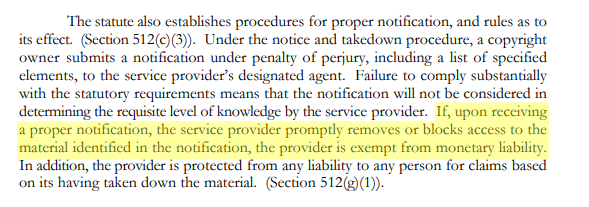
And according to US Copyright law, Code § 512, we were protected from any financial liability due to our prompt removal.
We sent this over to the law firm issuing this claim on behalf of their client (the owner of the image) and explained we were within our rights to remove the image and not be liable for any financial responsibilities.
We waited three days but didn’t hear anything back. And since this law firm was only giving us 2 weeks to respond, we assumed they just didn’t like what we had to say and weren’t going to accept that as a response.
The first option is what I wanted to do. To go tell this law firm’s client to go pound sand.
We’re clearly protected from financial liabilities since we removed the image within a timely manner. More than timely. Impressively responsive, in my opinion.
However, fighting back always brings retaliation. And the last thing we want is retaliation from a law firm for something we clearly made the first mistake on.
We even reached out to our lawyer and looped him in on everything. Since the financial compensation amount was relatively small (too small for small claims court to be worth it) we figured fighting it might be a losing battle.
Again, to us, the amount was relatively small. That’s not to say it wasn’t a lot. It was. And we didn’t want to dip into our business savings to pay for this.
Additionally, we know in court we could beat this because the law was clear. But was there something we were missing somewhere? A loophole?
I’m also not the kind of person to roll-over and accept a loss. Which is what this would have been if we just paid it.
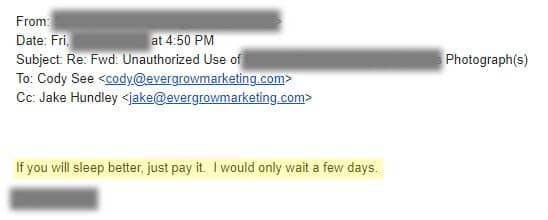
We asked our lawyer for advice and he just said to do whatever helps us sleep at night.
If you read the above header and thought we got out without paying the full $1,500. You’re wrong.
We paid them. In full.
We did this for one reason. But really three reasons.
The main reason is because it helped us sleep at night.
But the three actual reasons are:
1) $1,500 is too small for taking something like this to small claims court. We’d be paying court and lawyer consultation fees that would equal more than this amount.
2) The people who hired this lawfirm sued a major education company in the past and won. That wasn’t a challenge we wanted to take on.
3) We accepted the responsibility of my mistake.
That last one is important.
I made a mistake. And I accepted the responsibility and the punishment. Of course, we’re still curious how this would have played out had we fought back.
I think the lesson I learned most here was to accept the responsibility of your mistakes. They really do help you sleep better at night.
And you can bet your ass our library of LINCENSED images has grown exponentially since this event!
We learned that being honest with our clients is the best policy. Even when we screwed up, our client was still on our side.
We learned to pick our battles. Not every battle is worth having, especially when the victory isn’t actually coming out the “victor”.
And most importantly, we learned to just not use ANY images we don’t have explicit rights to. We also learned to document that in our processes so our employees don’t make the same mistake.
I don’t have a specific blog post for this, so I’ll include this here in case you’re curious. This would have fit better earlier in this story, but I didn’t want to detract from the main reason you started reading this in the first place.
The first question we need to ask ourselves is what images can we use. Ultimately, it’s just whoever has given you consent to use their image. It’s NOT whatever you can find on Google.
However, artists who wish to have the public use their images as if they were public domain images usually waive their copyright protections voluntarily with a “No Rights Reserved” license (CC0).
I’m still fuzzy on what that really means.
But I do know that there are a few websites where artists voluntarily upload their work for use by nearly anyone for free. A couple of them are:
Well, there’s really tons of them. But 99 Designs has a list of 31 of these sites.
A fair warning, you’re probably not going to find anything good on these sites. Public domain and anything “free” usually follows the saying, “beggers can’t be choosers”.
If you find an image you like and you’re unsure if it’s a public domain image and it’s not listed on one of the sites linked to above… GET PERMISSION TO USE IT.
Make sure it’s written. Whether it’s an email or a hand-written letter. Get permission.
The easiest way to get permission is to just pay for the damn licensing. Most photo / image sites have some kind of purchase or subscription plan.
And let me tell you what, $2 – $5 per image is a lot cheaper than a $1,500 shakedown.
Multiply that by how many images you stole and you’ll be wishing you could have paid $10 per image.
A lot of the image sites that 99 Designs listed above also include images from artists that still retain the copyright to their images, but you can typically purchase them individually or with a subscription plan.
Of course, my favorite site right now is 123rf.com.
The more I read about successful entrepreneurs, the more I realize a common theme; a fair amount of them regret never having documented their time while starting their business.
They don’t have any video diaries of their first years or even any posts or notes. I don’t want to live regretting I didn’t do that.
However, I am writing this kind of late. I started conceptualizing Evergrow in 2017 and it’s…December 22nd, 2020 at the time of this writing.
Fortunately, I do have some documents as well as a 10 minute video diary I just watched from December 2018 reflecting on the past year and a half. So I’d say I’m pretty well refreshed on my own history.
This will be the start of my posts I’ll write about my yearly journey in creating a business from scratch.
No seed investors.
No parent’s money.
No “life savings”.
Just a computer and dream (that was corny).
This one will be boring. I just always feel like we need a backstory to why a decision was made. I feel like it can provide some great context for the story later.
The Precursor: January, 2017
Mudd Advertising
It was January 2017 and I was gearing up to move to Kansas City from my home town of Cedar Falls. I needed to find a job.
I had been working at a marketing agency for about two years and had started as a Client Services Representative. It was an entry-level job making $28,000 ($14/hr) per year.
It’s here where I found my passion for marketing. I took a class in college on it… right before I dropped out, but it was Mudd Advertising that gets the credit for it.
I busted my ass here.
I worked long hours just to be the best Client Services Rep. I had eventually climbed the ranks and in less than the two years I was there to the Account Executive position for the agriculture division.
It was a fancy title for, “I get to keep all of my Client Services tasks while also managing and selling smaller accounts in the agriculture industry”. But it had effectively raised my salary to almost $40,000 after comission.
To me, $40,000 was a good amount. I think that’s what my dad was making in the early 2000s in his mid-30s.
However, I knew I was too driven to stop at $40,000 and Mudd wasn’t going to move me any higher. I had learned what I needed to know in marketing to take to Kansas City with me and make some moves.
Mudd overworked and underpaid us. It was probably one of the worst jobs I had. But it was the job that put me where I’m at now.
The Move / Hammel Scale
With my marketing background, I was able to create a compelling marketing resume despite not having any formal education in the area.
I landed a job in Kansas City, Kansas as the Inside Sales & Marketing person at Hammel Scale, a small, industrial scale distributor.
It was a small company but they gave me creative freedom with marketing at first. Plus they started me at $47,500, which was a heathy increase . I didn’t feel like I was taking a step back.
But something never felt right while working at Hammel Scale. I wasn’t educating people on digital marketing like I was at Mudd. That’s what I wanted to do. I wanted to educate and execute it.
The Catalyst: March, 2017
Around March of 2017, I was living at my new place in Prairie Village, Kansas with my then fiancée. The biggest issue with that place was the backyard was literally nothing but dirt and creeping charlies.
when it rained, our dogs would go out, get muddy, then we’d have to dry them off and wipe the mud off of their paws before they came in.
So I started looking for lawn care services to fix this problem. Maybe a full yard of grass will help.
As I was searching through Google, I noticed there were a lot…and I mean A LOT of lawn care businesses. And literally all of them except for maybe two had their Google My Business listing optimized let alone claimed.
Their websites were even worse… just God awful. It should have been a crime.
The Idea
I had never actually executed marketing for another business. I just knew about it. Sold it. Reported on it.
But how hard could it really be?
I knew there was an opportunity here. There was an opportunity to get these lawn care businesses to stand out over TrueGreen, BrightView, and the local Kansas City Metro gian, Ryan’s Lawn & Tree.
I just didn’t have a team I could turn the lead over to execute the plan.
I started where the most obvious answer was.
Optimizing their Google My Business listing.
The original idea was really simple.
A one-time, $250 fee for me to claim it and optimize it for them.
Clearly I wasn’t an entrepreur at this point. The biggest flaw in this being that this is a business model for “extra income” and not “recurring income”. And that’s probably what it was intended as when I first started it.
So I got to work on figuring out how to claim and optimize a Google business listing.
Yeah, I still didn’t know how at this point.
Needing a Guinea pig: April, 2017
I didn’t want to start doing this by calling up a random lawn care or landscaping business. I wanted to be a bit more discrete about it and make sure I was doing it right.
So I started looking at who would allow me to do this for them for free.
Churches.
Churches will take anything for free.
I reached out to a couple local churches to see if they’d be willing to let me claim and verify their Google listing. I had to meet with a couple of them to explain the benefits and the process.
The process was literally just me saying,
“I honestly don’t know how this is going to go. I used to sell these services and my team handeled it. I’m starting my own business and want to learn how to do this on my own. That’s why I’m offering this to you for free.
This is where I was able to learn how to perform simple tasks and I could actually get my business off the ground.
But I waited still. I waited until I was a bit more comfortable.
Learning & Getting Certified: May, 2017
I wasn’t yet comfortable with the idea of taking people’s money to perform a task I wasn’t an expert in. I didn’t have any confidence in this yet.
So I decided to get Google Analytics and Google Ads certified. This was something I could have done at Mudd. But it didn’t come with a pay raise, so I never did.
These classes are free on Google. They’re also extremely valuable. Especially if you ever expect to call yourself a digital marketer.
Taking these wasn’t fun. But I knew it was a step in the right direction.
Long story short, I got certified.
But in the meantime, I used my new marketing knowledge and kept applying it to my day job at Hammel Scale. This, of course, was because what I had with my business idea wasn’t really anything other than an idea at this point.
I was preparing.
That Tai Lopez Training Course
Look, we all make mistakes.
Some of us forget our anniversaries while others join MLMs, peddling products that are overpriced and poor quality. Messaging people from highschool they haven’t talked to in years with “Hey Girl!”
Mine was watching an entire Tai Lopez video ad on Facebook.
It was a video ad on starting your own 6-figure per month social media marketing agency.
It was a good-ass ad.
it was so good, I loaded my credit card up with a $1,200 charge to pay for this damn class.
Don’t make my mistake! Yes, I learned a couple things, but those things you can learn for free! The topics I learned about are below. So just take that advice and save yourself the money.
I thought it would have a lot of useful information in starting by own marketing agency.
I’m not going to lie. There were actually some good things in the video they covered. They talked about LLC vs S Corp, having confidence, and creating tiers.
It was when they started talking granularly about stuff that was just a bunch of horse shit.
Their SEO and Google Ads practices were way out of date and they were teaching things that would get you banned from search engines.
I never finished the course and received my “certification”.
At the end of the day, I’m happy I took the course, though. It did teach me some things about owning a digital marketing agency and getting set up. Beyond that. Nothing.
Niching Down
The BIGGEST takeaway from the shitty Tai Lopez course I took was a simple concept:
Find your niche.
In otherwords, if you’re going to be a marketer, don’t market for every type of business. There’s no value in a jack-of-all-trades.
But there is a ton of value in a specialist.
I thought back to my original business idea of the Google listings for small businesses. I thought niching down was going to be dumb. It was going to severely limit my target market.
But I did it anyways and I stuck with it.
After heavy consideration, I picked lawn care.
It Felt Like the Perfect Fit
There were three reasons why lawn care and landscaping niche felt like the perfect fit.
The industry was very behind on digital marketing. The opportunity was definitely there.
I’d always wanted to start a lawn care business with my dad. We’d talked about it for years, but never did.
I was already familiar with the green industry from working with agriculture clients.
Everything just seemed to kind of fall in place. I felt at peace.
Deciding on a Business Name: June, 2017
At the end of the day, I was a digital marketer. Whether I had just learned how to perform simple digital marketing tasks or not, I knew what I was talking about when it came to digital marketing practices and theories.
Your business name is great, but the domain for the website is better. I knew that going into this and that’s how I decided on my name.
I didn’t want to have my first or last name in it. I wanted the option to sell the business with its own brand identity in the future if I ever decided to entertain that idea.
I also wanted to have some meaning that related to the green industry. Additionally, a simple .com had to be available. I wasn’t going to settle with a .org, .net, .biz, or whatever.
The problem was, almost all of my domains were taken.
I went through so many of these, that I started helping other people find domains for their business when their first choices were taken in the years to come. So much so, I ended up writing a blog post about it on the Evergrow website.
Anyways, it went through a bunch of iterations before I landed on evergrowmarketing.com. The domain wasn’t taken and no one else had registered that name.
Recently, a friend from church asked me if I’d be willing to give someone he knew from chruch advice on starting his own marketing agency.
He was a young, fresh-out-of-college kid who was hungry to start his own marketing business. In other words, he had been brainwashed. And I had to undo everything he had learned whether it was from antiquated, college, marketing lectures or bullshit, get-rich-quick, marketing agency courses from online “digital gurus”.
After exchanging about three or four messages, I knew exactly what he thought about marketing, what he thought worked, and how soon he was going to fail if he kept on thinking the way he did.
He sounded like every other “digital marketing guru” in the world. The same polished turd that floods your Facebook and LinkedIn feeds with dumb, rhetorical questions that have obvious answers.
Yeah… those are the ones.
He seemed to blow off a lot of the answers I gave him. If he didn’t like what he heard, it seemed like he thought I was wrong.
Honestly, I don’t care. I have the successful marketing agency. He doesn’t.
So with that, here is my advice to those young marketers willing to listen… and probably be offended.
The number one reason people fail at starting a marketing agency (besides they simply don’t know how to run a business) is because they think what Tai Lopez teaches actually works.*
*Not an actual statistic…
It doesn’t.
Tai Lopez’s marketing agency course has about the same success rate as being successful in a multi-level marketing business (legal pyramid scheme).
It’s built on the idea that your potential clients are morons and you’ll be able to swindle a minimum of $5,000/mo out of anyone.
Your clients aren’t idiots. They’re business owners. And business owners are 200% smarter than nearly every marketer out there.
Before you make your judgements, yes, I took a Tai Lopez marketing course to see what they teach. It’s 10% good marketing practices, 20% outdated marketing practices, and 70% assuming your prospects are idiots.
The real idiot is the one thinking they’re getting value out of these courses.
And it’s not just Tai Lopez. It’s any of those social media, marketing influencers who have some proven method to success for your agency.
Take your pick. Billie Gene, Dan Lok, I’ll even throw Grant Cardone in there.
This almost goes without saying. If you’re going to niche down, you need to understand your niche. Not just the market, but the trade.
If your niche is dentistry, you better know a lot about dental practices. Learn what services go hand-in-hand with each other, how often you can get a patient to come back to the office. Learn about how dental insurance works.
In other words, think as if you own a dental practice. You don’t have to be a dentist. Just understand the business and how it makes money the best.
Read books about running your own practice. There’s literally a book on everything. Here’s one on how to run a successful dental practice (I Googled this after I typed this example).
My business focused on the landscaping industry. That lead me to read books like:
It’s my belief marketers don’t know how to handle money. They may know how to allocate other people’s money. But if the amount isn’t dictated by an outside party, they’ll blow through it faster than a teenage girl at an outlet mall.
In turn, they don’t know how to properly run a business. So when you get turned down, it’s because your solution didn’t make practical business sense.
You have to realize marketing is certainly a positive investment for anyone. But YOU may not be. If the business didn’t buy into your marketing plan, it’s probably because:
Your plan didn’t solve THEIR problems
You didn’t quantify how you could help them in terms of their own profit numbers
They just don’t trust you
If a business rejects your proposal, it’s not because they don’t see the light. It’s because you didn’t present a solution that solved their problem.
You need them to tell you what their problem is.
Business owners work to solve problems. Marketers look for problems to solve.
Don’t look for problems. Listen and provide a solution if you have one. If you don’t, then let them know. You don’t have a solution for everything and you shouldn’t.
On that note, be sure to humble yourself. You don’t know everything and you’re not expected to. You’re expected to find the solution to a problem.
I’ll admit. When I first started out, I was a bit arrogant (I also realize I’m being pretty arrogant in this blog post…).
My word was law in SEO and even social media (though, I really didn’t know that much about social media at the time).
I knew a lot about SEO, but the thing with SEO is that a lot of it is really subjective. Google has over 200 ranking signals and they do their best to not give away their secret.
So I’d say absolute statements like, “Image titles and file names don’t affect rankings, only alt-text” or “Duplicated content negatively affects your ranking.”
In case you’re wondering, the first statement isn’t for sure known, but it’s a best practice… just in case (If I owned a search engine, I would definitely look at these). Regarding the second statement, I haven’t seen anywhere that duplicate content affects your rankings negatively.
But it doesn’t help the duplicated page.
I’ve even burned some bridges being arrogant and argumentative to other SEOs. Was I right in a lot of cases? Sure. But it doesn’t matter.
The funniest part of all of this was I was never explaining any of this in detail to clients or prospects. So why the hell was I even doing it?
Humble yourself. You’re not a god and no one expects you to be. They expect you to be honest and personable.
It’s not your job to know the answers. It’s your job to find the answers.
Let me knock this one out right now. Your formula for marketing success or attracting leads isn’t a secret. I can guess it right now.
First you deploy an ad on social media (probably Facebook) that has an enticing offer in it to get signups. Like it’s some kind of sweepstakes. Just enter some information for a chance to get free {insert product or service}.
Then you get a bunch of (unqualified) leads.
You then use those leads and set them up in an email database that deploys scheduled emails. Probably 4 or 5 and the content changes depending on how they interact with the email (or don’t).
Those emails lead them through a “sales funnel”.
Your client then gets lots of still, unqualified leads. They’ll close some, but they’ll be shitty customers (oh sorry, you’re not supposed to know that yet).
Finally, you’re using ClickFunnels. Or some knockoff to do all of this.
This is a short term strategy. It’s not meant to get repeat customers or work forever. Does it work? Sometimes. But more often not. Especially if you’re not in the ecommerce industry.
Your secret isn’t a secret. It’s been beat to death.
The only thing worse than a used car salesman in the early 90s is a marketing entrepreneur.
I actually wrote a post about why people hate digital marketersawhile back. I encourage you to check that out if you have some time.
In the beginning, it was easy to sell things like SEO. High ticket items with minimal effort. At least it was for marketers at the time.
They (and still do) played on the ignorance of business owners. Throwing out buzzwords like “meta tags”, “alt-text”, “link equity”, etc. Things real business owners don’t have time to learn or understand.
“Sure, whatever, just take care of it.” Is typically what went through their minds.
It’s still the case.
But more and more business owners are catching on to that. They’re not stupid. In fact, they’re smarter than most people who call themselves marketers that rely on 3rd party apps like ClickFunnels.
If you want to stand out, you’re going to need to establish trust first. You need to help, not sell.
When I first started, I set out to become a resource for landscaping and lawn care business owners. I didn’t sell and I didn’t promote. I just helped and answered questions.
If you want to get an idea on how I “helped”, check out this link. Someone posted their website on a landscaping business owner forum for critiques. So I gave them… in detail.
I made it so if he wanted to do his own SEO, he could follow everything I said and didn’t need me.
This is the kind of credibility you need to build for yourself. It’s also the exact same thing that Gary Vaynerchuck preeches in his books “Crush It!” and “Crushing It!”.
SALES WILL COME.
They did for me. It just took a little while for the credibility to start building.
It’s no doubt that your business can’t succeed without sales. So naturally you feel like you need to be salesy and create an enticing pitch.
You don’t.
I would argue that being salesy and having such an exhuberant attitude when talking with a prospect is draining on them (and you) and keeps their guard up.
I find the most success when I treat them as a family member calling me. I don’t use any inflection in my voice, I don’t pretend I’m excited if I have nothing to be excited about, and I really don’t care if I get the sale.
The first thing you have to get through your head is that not all sales are good.
Trust me one this. You won’t. But I have to say it anyways.
Shitty clients are stressful. They’re the clients that want everything for nothing and make you bend over backwards for low margins. You don’t want this.
Instead, be an educator. Your leads should come to you. Not the other way around. To do this, you have to get your name out there.
Comment and help on forums
Write for industry related magazines and publications
Try to get featured on podcasts
Join social media groups (Do NOT pitch here. It’s an easy way to get booted and chastised)
Leads will come to you. And when they do, don’t be salesy. Vet your potential client and let them know you need to see if they are a good fit for you. Business is a two-way street.
They don’t have to buy from you and you’re not their slave.
The Office had a perfect example of this from the “best” salesman in the area.
Meredith: “So, you’re here to sell me some paper.”
Danny: “Well actually, no, Ms. Van Helsing, that’s not why I’m here. I’m here to meet you. To see if we’d be a good fit.”
If you didn’t dress in a suit and tie before you became a marketer, then don’t do it now. It’s not you. It’s inauthentic (I have a hard time saying anything relating to authenticity without thinking about Gary V. I feel like he could trademark that word by now).
No one’s buying it.
Your appearance and how you conduct yourself makes an impression. Unfortunatley, snazzy-dressed marketers look sleezy.
They should buy into you. Not someone you’re not.
Sorry for the long post
I didn’t mean to make this post so long. I had a lot to say, apparently.
The truth is, if you’re a marketer trying to get started, you have to realize you are a drop in the bucket.
If you’re trying to get noticed, you have to do what no one else is doing, and right now, that’s literally just being yourself.
If you’re a douche bag, naturally, you’re gonna have a hard time.
That’s all for now. I post a lot shorter content on my Facebook page if you want to give that a follow. Or don’t. I don’t care.