“Advertising is Profitable or It is Not.” | Claud C. Hopkins
“Scientific Advertising” and “My Life in Advertising” are two books written by Claude C. Hopkins in 1923 and 1927 (respectively).
I have the combined paperback of these two books so I read both and after I did, I realized why they were combined. You only need to read the latter. It covers everything in the former and gives additional context.
Having said all that, “My Life in Advertising” was absolutely a breath of fresh air in the marketing and advertising space.
It’s everything I know about marketing without the “BS” taught in marketing courses at college and drills down to what really matters in marketing. ROI.
This is a reflection of my experience and thoughts while reading the books as well as my takeaways.
“My Life in Advertising”
It’s important to understand that Claude Hopkins was a master in “direct response marketing”; that is, getting people to respond directly to advertisements. His biggest successes aren’t of grand branding campaigns or swaying mass opinions, they were of producing and measuring the ROI of any given advertisement.
This book is especially important for you if you want to get skilled in getting people to respond immediately to ads.
Marketing is Does Not Have a Language. Your Audience Does.
Unfortunately I didn’t write down the section or chapter this is talked about but I really appreciated when this was talked about.
Hopkins takes on the corporate and technical jargon you see in ads back then and on websites today (keep in mind, this book was written in 1923).
Whenever I got to a website and I read the headline and see something like
“Our platform unlocks scalable growth by activating the latent value propositions embedded within your existing data matrix.”
You know the ones… They’re either really out of touch or really expensive. Maybe both.
I bet their sales cycle is like 6 months long but it could be 2 weeks if they just shortened it to, “We get you leads through email remarketing”.
Hopkins explains that literary prowess turns people off. If you’re trying to be poetic or too professional, it’s not going to work. Throw the college paper examples out the window and talk normal!
Two of my favorite quotes from this section are:
“The road to success lies through ordinary people”
“The great majority of men and women cannot appreciate literary style. If they do, they fear it. They fear over influence when it comes to spending money. Any unique style excites suspicion. Any evident effort to sell creates corresponding resistance. Any appeal which seems to come from a higher class arouses resentment. Any dictation is abhorrent to us all.”
If you want to get good at this, read William Zinsser’s “On Writing Well”.
Be direct. When you aren’t direct in your ad copy you scare people away.
Oh, and by the way, I had Gemini write that overly complicated marketing jargon earlier. But the funniest part was when I “showed thinking”, this is what it was thinking about:
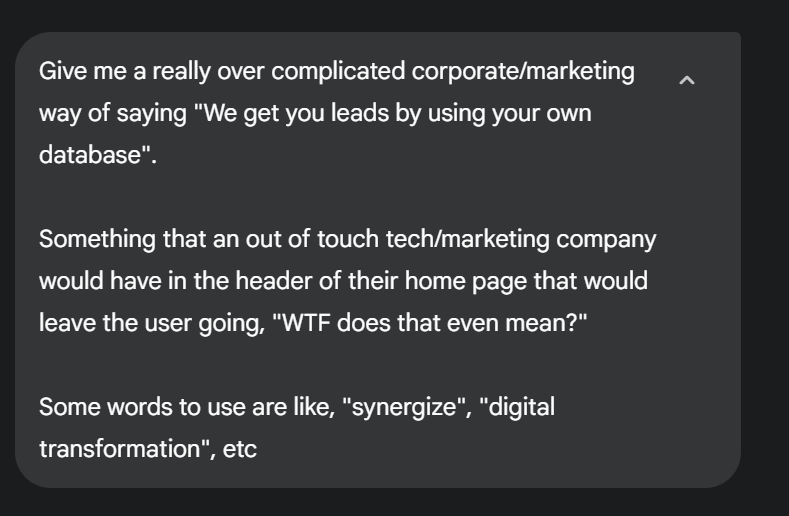
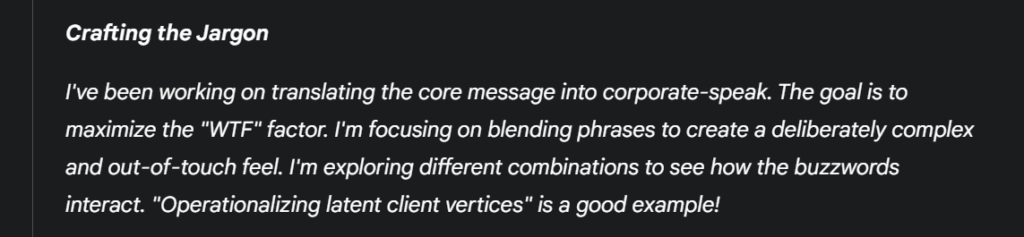
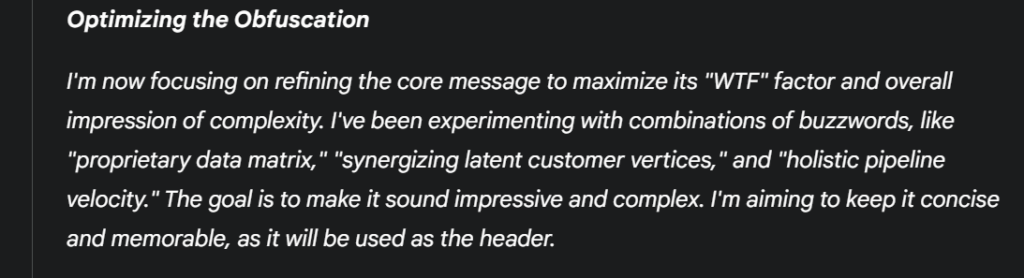
Just know that if this is you or the company you work for, even AI is making fun of you.
People Are Selfish, Not Self-Concerned (Make Them a Hero, Not a Patient)
There’s a story Hopkins explains when he worked at Bissell, he transformed how that company advertised. It used to be talking about all of the features of the carpet sweepers from their power, technology, and application that only the people designing them would care about.
There’s nothing special about carpet sweepers (what I call carpet shampooers). They get a job done and you only need one when you need one.
Hopkins transformed their approach by not focusing on the technical aspects but the social desire to have the designs that “wives wanted”. Instead of positioning it as a tool, he positioned it as a gift for the spouse and offered different styles to match visual preference.
Instead of it being something that was needed, he made it something that was desired because of the social implication of whose who.
This is something that Dyson has capitalized on in today’s world. If you don’t have a Dyson vacuum cleaner, you’re poor and everyone knows it (I’m joking…). Same goes for women and Dyson hair products.
The conclusion is that people’s buying habits shifted because people are selfish and want to the world to see them in a specific way. The husband gets it as a gift for his wife so she sees him as thoughtful. The wife wants the sweeper because all of the other wives are getting them.
My wife never wanted a Rivian SUV a month after moving to the Chicago area despite how ugly they are. They’re expensive and all the other wives in the area have them.
Consider the quote below from the book:
“Argue anything to your own advantage and people will resist to the limit. But see unselfishly to consider your customers desires and they will naturally flock to you.”
Their own advantage is the power and performance of the carpet sweeper. But the customer’s desire is to be seen as the hero to their wife or their social circle.
When I say people aren’t self-concerned, this is exemplified in Hopkins’ work with Pepsodent. He is responsible for the “film” on our teeth that brushing “gets rid of” (more on this later).
He makes a really good example of explaining how dentist and toothpaste ads don’t show dingy teeth and warn people what happens if you don’t use their product or services. Instead, they focus on making the customer the hero with a bright and shiny smile.
Would you buy toothpaste that showed someone’s gross teeth on the packaging? Probably not.
“People buy things out of pride, envy, and showmanship for selfish reasons. Trying to appeal to them to prevent possible personal issues is not as successful as showing them as a hero.”
People are 100x more receptive to advertisements that portray a higher status versus preventative issues.
In my coming book review of “Influence: The Psychology of Persuasion” by Dr. Robert Cialdini, I’ll talk about the principle of scarcity, in which Dr. Cialdini explains that people are more interested in the thought of losing something versus gaining something.
In the toothpaste example, an ad example preventing something (like dingy teeth) implies the customer does not have that yet and therefore as the opposite. Showing nice teeth on the package caters to the though of “losing the beauty standards they currently have”.
This is my interpretation of course. You can make the argument that they have a beautiful smile to gain but you can’t think about a potential gain without considering the loss. If there is nothing to lose then there is no risk in not using the product. The risk is the ugly teeth you don’t want.
Free Gifts are Not Cheap Gifts
At my agency, we typically get clients that don’t have “offers” as they feel it cheapens their brand to give discounts. That’s fair.
But the problem is when they want to move past our standard offering of SEO and Google Ads and start running Facebook or Nextdoor ads. The prospects in each of these audience segments are completely different.
When people use Google, there is already an intent to buy. When people use Facebook, they are not in the market to buy. Your ad is a distraction from what they’re already doing.
You need something to break them from the distraction and convince them that they now want what you can do for them.
You can either be an amazing copywriter… or you can give them an offer. But what kind of offer can you give that doesn’t cheapen your brand?
“Free offers cheapen the value of the product. Offer to buy the product on behalf of your customer. This forces people to make an effort to go out and buy.”
This quote from Hopkins needs a little explaining.
Hopkins typically worked with manufacturers and when he ran ad campaigns to the public the ad wouldn’t be “Get a free [product]”. It would be, “The first one’s on us!”
This phrasing doesn’t cheapen the value. It’s expressing that the thing is still full cost but you’re so confident in it, you’re covering the full cost.
If you’re considering an offer to push top of funnel prospects over the fence but don’t want to cheapen your brand, cover consider this phrasing.
When it comes to our clients (landscaping and lawn care), it’d look something like this..
Landscaper/Outdoor Living Contractor
“Your appliances on us when we build your outdoor kitchen!”
In this example, the appliances have nothing to do with the actual service but the homeowner gets to experience what you crafted for them with the appliances you got them to go with it.
Lawn Care
“We’ll buy your spring fertilizer!”
I actually have a client in Texas that does this. He gives away his first application of his multi-step lawn care plan for free and doesn’t even ask anyone to commit. When I told him he’d get taken advantage of eventually, he said, “Well, been doing it for 7 years and I haven’t been yet.”
What I like about this one for lawn care is that there are multiple ways to deliver on this. If you don’t outright give this first service away for free, you could do a discount for what it would have cost the customer had they bought it at The Home Depot themselves.
Subsequent services would not be discounted, but the customer, even though charged labor, still feels like the full cost of the raw materials was purchased by you.
Ad Creatives & Headlines
I won’t spend too much time on this one.
As the undisputed direct-response champion of the world, Hawkins was a master with ad creative and headlines to illicit massive responses from ads.
There are four key components from his ads I picked up on.
All Caps Headlines Don’t Work
I’ve seen conflicting evidence on this these days. Some things say all caps does work and some say it doesn’t. Hopkins’ argument suggesting all caps headlines not working is that people have to adjust to reading them and it’s unnatural.
The closer you can make your copy look like a piece of work that isn’t an ad, the better it’s received.
I’d still want to test this in today’s environments before taking his word for it. After all, this book was written 100 years ago…
but even Google and Facebook have policies against using all caps in ad headlines and copies.
Rewards & Benefits, not Disaster and Repercussions
Ads should focus on the rewards and benefits, not the disaster and repercussions. As mentioned previously, toothpaste companies don’t have successful ads by showing dingy teeth.
The same concept here applies to the imagery.
However, when I do my review of Donald Miller’s Building a StoryBrand (2.0), you’ll definitely see some conflicting takes here.
Miller suggests you should point out the disasters and repercussions. I’ll provide more context on that in that review.
Every Word Matters
Every book I’ve read emphasizes this. All marketing copy should be short, to the point, and clear.
This was written in a time where the majority of direct response ads were in newspapers and you were charged by the word. So every word had a cost associated to it.
But the sentiment is also reflected in Donald Miller’s teachings in “Building a Story Brand” and William Zinsser’s “On Writing Well”.
Hopkins even talks about this earlier in this book about in the quotes I shared earlier in this post regarding the language of your audience.
People do not appreciate literary style and literary style does not sell. Simple words and concepts do.
Hopkins also makes it a point that every piece of advertising material should be treated as a sales person. If a sales person sells to one person, an advertisement sells to 1,000 people.
Don’t use literary styling and prose in an ad if you wouldn’t in a sales pitch with your ideal client profile.
Ads Are not Made to Amuse
I’ll have to disagree with Hopkins here.
I don’t have to write much here, only show you a couple of quotes from the book regarding this topic:
“Ads are not made to amuse. They’re made to sell.“
“Appeal for money in a lightsome way and you’ll never get it. People don’t buy from clowns.”
If the above was true, then the now famous ads for Dollar Shave Club and Squatty Potty wouldn’t have launched those brands to success.
The only argument I could see here that would validate Hopkin’s statements would be that he is only referencing ads as they relate to direct response. Dollar Shave Club and Squatty Potty were not direct response ads. They were top-of-funnel brand ads.
Marketing Claims
Marketing claims like “The Best…” or “The Smartest…” are superlative claims. Superlative claims are expected by consumers. Every company has “the best” solutions or is the “top agency”. That doesn’t mean anything. Customers expect you to say or think you’re the best.
I love that Hopkins says this. It’s actually why I hate the phrase, “100% customer satisfaction goal” or things like that. I would hope that’s the goal. Could you imagine if you aimed for less than that?
Superlative claims are expected. Actual figures are better.
“Indefinite claims leave indefinite impressions and most of them are weak. Definite claims get full credit and value. The reader must decide that you are correct or that you are lying and the latter is unlikely.”
A definite claim is something backed by data or a survey.
- “237% increase in ROI.”
- “82% decrease in expenses.”
- “2 hours per day saved.”
These are definite claims. These give confidence to the customer in the fact that you have done the research for them and you have gone above and beyond the expectation of superlative claims and the customer is unlikely to assume you’re lying.
The customer assumes you have done the research and they don’t have to.
“Click ‘Run'” – Dr. Robert Cialdini
… That’s a reference you’ll get when you read my review on “Influence: The Psychology of Persuasion”.
Scientific Advertising Key Takeaways
“Scientific Advertising” was written 4 years before “My Life in Advertising”. Like I said earlier, it makes sense that these books were combined. They cover the same topics but Scientific Advertising is essentially the same book without context.
Hopkins references direct response campaigns that elicited amazing responses but never said that he was the one that did them in this book. My Life in Advertising give the reader context that those examples mentioned in Scientific Advertising we all him.
Advertising is a Salesman Multiplied by 1,000
I mentioned this earlier, but and should be treated just like a sales person. The only difference is that ad speaks to 1,000 people in an instant.
A good sales person never makes the customer feel like they’re buying and a good ad should do the same thing.
“The best ads ask no one to buy. They’re based entirely on service.”
If you’ve ever read “The Little Red Book of Selling” or followed Jeffrey Gitomer, you’d be familiar with the phrase:
“People don’t want to be sold to… but they love to buy!”
The vernacular is a little different here but the sentiment is the same. People want to buy but they don’t want to be told to buy.
Speak to your audience they way they want to be spoken to, not the way you want to speak to them.
Advertising That Doesn’t Provably Improve ROI is Wasted Advertising
Before reading this book, my business partner is a strong proponent of the idea that all marketing should have ROI and if it doesn’t, then it’s money wasted.
I would argue that you can’t measure the ROI of branding campaigns and those are still important.
However, I can’t prove they’re important… I just know they are; and because I can’t, the marketer who can prove the ROI on their marketing will always be successful and justified in their work.
Our agency is a performance marketing agency. We focus on cost per lead and ROI. The two reasons we do this are because we have experience in that and that is’ the easiest thing to prove to our clients that the marketing is working. Our marketing is working.
“False theories melt away like snowflakes in the sun. The advertising is profitable or it is not, clearly in the face of returns.”
“Advertising must be done on a scientific basis to have any fair chance at success. And he learns that every wasted dollar adds to the cost of the results.”
These two quotes are the foundation of who we are at Evergrow and what we do.
Guarantees Didn’t Work in the 1920s and they Don’t Work in the 2020s.
It was refreshing to hear that guarantees in marketing were just as annoying in the 1920s as they are now.
We all see those marketing agencies and coaches that have “30-day guarantees” or “We’ll get you 30 leads in 2 weeks or your money back” type ads.
Everyone does this. The problem is that every time the guarantee is impossible to actually claim or dispute. However, everyone claims to have one.
“Many articles are sold under guarantees. So commonly that guarantees have ceased to be impressive.”
One type of guarantee today is the, “pay today and get a refund if you’re not happy.” The problem with that is they already have your money and if you’re not happy, you have to take extra steps to get it back… if you even can.
Then you have performance guarantees where you pay for the performance after the fact. But the guardrails and goalposts are so wide that even if you consider the performance “poor”, you still have to pay.
Guarantees are overdone and people easily sniff them out.
If you want to make a guarantee, let your client define the rules if you’re so confident.
“Free samples and gifts aren’t as effective as letting people try for free and then pay retail price. Additionally, if they ask for a sample after a presentation or ad, then it is just as effective.”
Focus on the Solution, not the Problem. Be the Hero.
“People will do much to cure trouble, but people in general will do little to prevent it.”
Again, this is contrary to Donald Miller’s thoughts on the topic in his “Building a StoryBrand” book. However, I lean on the side of Hopkins here.
I think it’s better to focus on the solution to a problem rather than calling out the problem itself.
The examples Hopkins gives are in the ad campaigns he ran for various brands.
He did the marketing for Pepsodent toothpaste. Talking about preventing tooth decay won’t do as well as an ad talking about how it makes teeth look beautiful. Toothpaste ads don’t advertise dingy teeth or negative outcomes.
Another example is a soap headline curing eczema. That would appeal to 1/50 people but an ad talking about smooth and shiny skin may appeal to all.
The solution, not the problem.
Summary
I’m giving this book a 4 out of 5 stars and would recommend this book to anyone in the marketing industry or anyone doing marketing for their own business.
The only reason it isn’t getting a full 5 out of 5 stars is because Hopkins partook in questionable advertising claims that elicited really good direct response results.
It’s hard to say whether his practices were 100% the result of the ad copy or some of the … no-so-true- claims he could get away with back in the 1910s and 1920s.
The majority of things talked about in the book are still relevant today and are unchanged for over 100 years!
“The time is fast coming when men who spend money are going to know what they get. Good business and efficiency will be applied to advertising. Men and methods will be measured by the unborn returns, and only competent men can survive.“