

It’s been 5 years since I’ve written a book review. For reasons I won’t get into, I’ve had a fire ignited under me for the pursuit of knowledge.
I’ve started diving into classics like 1984, Animal Farm, and Fahrenheit 451 (never mind that they all follow the same theme…). Before diving into Brave New World, my wife made me promise to read “The Company I Keep: My Life in Beauty” by Leonard Lauder.
She’s an executive in the beauty industry and previously worked for Estée Lauder Companies — when she read the book herself.
She praised the lessons given in the book by Leonard Lauder and how his advice and life lessons both validated and influenced her leadership styles with her teams. As a business owner myself, it was a no-brainer that she recommended this book to me.
As promised, I finished Fahrenheit 451 and picked up My Life in Beauty.
Synopsis / My Perspective
This is an autobiography. It’s good. And there are a lot of good lessons in leadership here.
Leonard Lauder is the son of Estée Lauder and the succeeding CEO of the Estée Lauder Companies and creator of brands like Clinique.
Obviously the book will cover a lot of the history of Estée Lauder and the company itself, which is interesting in its own right, but that’s not why the book was recommended to me.
The book was recommended because a large portion of the book has to do with leadership style’s and ideas Leonard Lauder brought to the “Family Business” after pursuing a career in the Navy. You’ll understand why I put quotes around family business in another section of this brief review.
A Family Business vs a Family in Business
This is a theme that shows up a lot in this book. There’s a difference between a “family business” and a “family in business”. In short, Leonard Lauder tackles nepotism head-on which is something I’ve always been concerned of if I had a child and they wanted to join my business.
In short, a family business is a business where the business serves the interest of the family while a family in business is a business where the family serves the business. The former is susceptible to selfish interests of family members and internal family struggles and arguments. The latter puts the business first and implies the family just happens to be in business together but all positions were earned.
Family in the Lauder Companies needed to start from the bottom and there was always a degree of management separation between the youngest Lauder and the eldest in the company.
Although I don’t think it completely squashes internal rumors of nepotism.
One of my favorite quotes in the book is actually related to this idea and that’s a quote Leonard references related to family businesses:
“… the first generation builds them, the second generation enjoys them, the third generation destroys them.”
It’s a trend he aimed to break with his own children joining the company.
At the time of the book publishing (2020), Estée Lauder Companies stock was soaring. But the next two years saw the steepest decline since almost their early days.

As much as I enjoyed this book and his lessons, I’m not confident he “broke” this trend.
The Pussycat Clause
One thing I really appreciated from this book was “the pussycat clause”. This is probably the number one thing my wife took away from this as well as she repeated it to me quite frequently before I had even read this book.
The premise of this came from a story where in the book where Carol Phillips (former editor of Vogue) was brought on by Leonard Lauder to grow the Clinique brand.
When a well-qualified friend of hers expressed great interest in joining Carol in growing the brand, Carol responded with:
“Well pussycat, I can’t hire you… because I can’t fire you.”
I love this quote.
Cody and I actually talked about it in episode 19 of our podcast. We’re not fans of hiring our friends and family because of things that can go wrong in that relationship. It’s also not particularly comfortable telling friends and family you don’t want to hire them because of what could go wrong.
That’s like getting engaged and planning for a possible divorce.
But when you explain it like Carol did, it’s more endearing and protective.
I think if you live by this phrase and do hire a friend or family member… they should really be questioning where they stand in your relationship…
Competing Against Yourself
This is one of my favorite segments of the book.
It’s a common practice for a company to dominate a particular market or demographic and then try to appeal to another demographic, often leaning on their already established brand voice and positioning.
However, we’ve seen this fail multiple times in abysmal campaigns like:
- Bud Light appealing to a broader market using Dylan Mulvaney in their ads.
- Jaguar’s “disastrous” diversity rebrand
- Oldsmobile’s “Not your father’s Oldsmobile” campaign
Estée Lauder was seen as a prestige brand, it still is today; but there were emerging market trends where consumers emphasized needs for products that were fragrance and allergen free as well as products that were green an “all natural”.
Estée Lauder didn’t need to appeal to these market demands, it would have only devalued their brand in the eyes of their already captured market. A market that didn’t care about these things nor want fragrance free products.
Instead of positioning themselves as a brand that catered to all of these Leonard Lauder proposed and executed the idea of creating and owning competing brands.
Origins was created to cater to the all-natural market demand and Clinique was create to target the dermatological needs of the skin care and beauty industry.
These internal competing brands targeted multiple audience demographics without alienating their current audience with Estée Lauder.
This is reminiscent of Colonel Tom Parker’s (Elvis Presley’s Manager) campaign creating “I Hate Elvis” buttons.
If there was a market that loved Elvis… there certainly was one that hated him too. Why not capitalize on both?
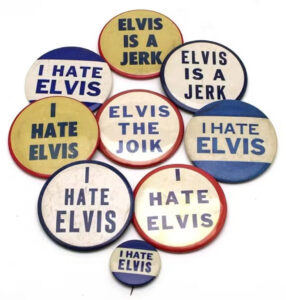
Applying this logic to my own business, a digital marketing agency for landscapers, if we were to add another industry or niche to focus on, such as roofers, it might make sense to create another brand.
Giving Away Your Best Product
Estée Lauder was one of the pioneers of the “gift with purchase” idea, but it didn’t start as “with a purchase”. It started as just a gift.
Estée Lauder would frequently work with department stores to have them send out letters to their shoppers prompting them to come in and get a free product from Estée Lauder. The idea is that customers would come in and purchase additional products from Estée Lauder as well as shop at the other counters in the department store.
It always worked better than everyone expected but when competitors tried to copy the idea, it fell flat on its face.
Why?
Because the free gift was never last season’s color or the weakest product that wasn’t selling just to get rid of the stock. The free gift was always one of the best products.
Always give away your best product. If someone’s first experience with your brand is with one of your worst products, why would they give you money for your other products?
Initially, my thought was, “Of course. Give them the smallest sample size of your best product. It’s not enough to make a sizeable dent in the cost of goods sold, and it makes sure the customer comes back to buy the full size once they realize they like it.”
Wrong.
Estée Lauder was giving away full sized products of her best products. Beauty is one of those industries where people become loyalists. It’s difficult to get people to switch, but once they do, you’ll have yourself a loyalist.
If you give them a full size of your best product, chances are they’ll switch to it when they run out of what they currently have. Then they’ll have yours for an amount of time they get used to it and need it again once it runs out.
It’s not about having them try the product… it’s about total conversion.
There’s more on that topic when I do my book review of “My Life in Advertising” and “Scientific Advertising” by Claude C. Hopkins.
Internal Praise and Criticism
I’m guilty of a few things here…
First, I’m bad at praising people. Even if what was done isn’t that breathtaking or groundbreaking, people like to hear “good job” and they like it when it’s said to them in front of other people.
Leonard Lauder explained how people became exceptionally motivated at the slightest amount of public praise.
Of course if public praise motivates people, then public criticism is sure to do the opposite.
All criticism should be done in private.
I’ve been guilty of this specifically and didn’t even realize I was doing it.
Just the other day I was going through a website that one of my employee’s built as we were getting ready to send to off to the client for review.
We were having a team meeting during this and talking about sending it over. During this time, I had notice da few mistakes. I was about to call them out while on the call but remembered Leonard Lauder’s words,
I held my tongue and set up a private meeting to go over the issues I found.
No one was in trouble and I wasn’t upset, but we shouldn’t point out mistakes or flaws publicly. It’s demotivating and demoralizing.
Memorable Quotes & Honorable Mentions
I’m awful at remember quotes and envy people who can recite them. So I wrote a few of them down that I really liked.
“When a person with experience meets a person with money, pretty soon the person with experience will have the money and the person with money will have the experience.” – Joseph Lauder
This was a quote Leonard heard from his father that he said was one of his greatest lessons in business.
“Trees don’t grow to the sky. They die.”
This is a quote is similar to “don’t put all of your eggs in one basket.” All trees die. You can’t expect to grow your tree (business) to the sky. It can get big but it will cap out.
Instead, focus on growing a forest of trees, no one tree.
“Committees are the death of creativity and productivity”
Leonard Lauder refers to committees as “The Anvil Chorus” which is a reference to a Spanish opera where gypsies bang on drums and sing about their life. The parallel is that too committees are like gypsies banging on drums and creating so much noise with little to no productivity.
I’m going to start referring to committees as Anvil Choruses. Maybe I’ll seem smarter.
“You can make tactical mistakes but not strategic mistakes. Tactical mistakes are ones that you make today that affect today. Strategic mistakes are ones you make today that affect tomorrow… and tomorrow’s tomorrow.”
This is probably a paraphrase. I didn’t put quotes around it in my notes on my phone, but the sentiment was meaningful enough for me to take pause and think about whether a decision I’m making is a tactical one or a strategic one.
In other words, will this decision affect only what we do today (or the immediate future) or will it have longer term ramifications? If it’s the former (a tactical decision), then quicker decisions can be favored.
Who I Would Recommend to Read this Book
I would recommend anyone in leadership to read this book. Whether you own your own business or work for one.
The book is for leaders of all kinds, but there is a lot of entrepreneurial advice and perspective to gain from it.
I don’t consider myself a great leader. I’m a nice leader, but that doesn’t mean I’m a good one. I believe the ideas in this book will continue to shape me as a leader and business owner.
I definitely recommend picking this one up. You can get it on Amazon. The audiobook is also available on Spotify (I recommend listening to it at 1.8x speed…